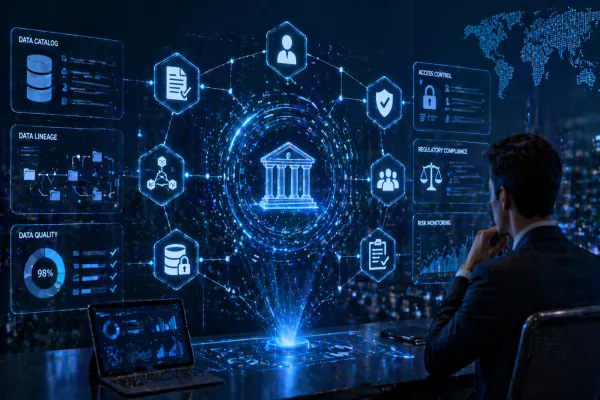

The risk landscape for global finance has moved beyond simple predictive modeling. For years, AI for risk management in financial services focused on "detecting" anomalies after they occurred. In 2026, the objective has shifted toward autonomous prevention and agentic orchestration. High-intent enterprise buyers now prioritize systems that do not just flag risks but actively mitigate them across complex digital workplaces. This article explores the architectural shifts required to maintain institutional stability in a multi-agent ecosystem. We will examine the critical technical silences in current market offerings and how to bridge them for sustained enterprise resilience.
The Industry Consensus on Risk Governance
The prevailing consensus among global Tier 1 banks is the adoption of AI TRiSM (Trust, Risk, and Security Management). Most institutions have moved away from general-purpose LLMs in favor of Domain-Specific Language Models (DSLMs). These models are specifically tuned to the nuances of Basel IV, AML, and local jurisdictional requirements. The industry has accepted that "Governance by Design" is the only way to scale AI without introducing systemic volatility.
However, a significant "Execution Gap" remains. While banks have the models, they lack the integrated digital workplace to manage them at scale. Fragmented knowledge remains the biggest barrier to AI ROI. Enterprise leaders are now looking for platforms that can unify siloed data into a single, risk-aware operating system.
Solving the Agent-as-User Identity Crisis
A critical gap in current industry discourse is the failure to address the technical reality of agentic identity. Most articles discuss "governance" as an abstract policy. They ignore the specific challenge of credentialing. When an AI agent performs a risk adjustment or executes a trade, it often operates using a shared service account. This creates a massive non-repudiation risk during an audit.
Valuebound specializes in building the Identity and Access Management (IAM) layers that treat agents as unique "Digital Employees." By assigning cryptographically verifiable identities to each agent, we ensure a perfect audit trail. This allows risk officers to trace every autonomous action back to a specific model version and approval workflow. Visit valuebound.com to learn how we implement "Zero-Trust" architectures for your agentic workforce.
The Training-Inference Sovereignty Gap
The market is currently talking about "Sovereign AI," but it is silent on the governance breakdown between training and inference. Many banks train their risk models on highly secure, on-premise datasets. However, they then deploy those models in hybrid cloud environments for inference speed. This creates a "Sovereignty Leak" where the model's weights could potentially be exposed or manipulated.
To solve this, 2026-ready architectures must implement Sovereign Inference Pipelines. This ensures that the model remains within the institution's jurisdictional control throughout its entire lifecycle. Valuebound helps banks design "Local-First" inference layers that protect sensitive risk logic while maintaining the performance of a modern digital workplace. We ensure your risk intelligence never leaves your secure perimeter.
Codifying Institutional Knowledge for Agents
Most CEOs want immediate ROI from AI, but they struggle to translate "human intuition" into structured data that agents can use. This is the "Knowledge Codification" gap. Risk management is often built on the unspoken expertise of senior risk officers. If this knowledge is not codified, your agents will make technically correct but strategically poor decisions.
Valuebound provides the semantic framework to bridge this gap. We help institutions build "Knowledge Graphs" that capture institutional wisdom and translate it into machine-readable prompts. This ensures that your agents act as extensions of your best human experts, rather than black-box algorithms. By grounding your agents in verified institutional knowledge, you eliminate the risk of "agentic drift."
The UI of Progress: Orchestrating Risk Swarms
A major technical silence exists regarding the real-time user experience for risk officers. As banks deploy "swarms" of specialized agents, the risk of data overload becomes real. Traditional dashboards are insufficient for monitoring hundreds of autonomous agents acting simultaneously. The strategic gap is the lack of a "UI of Progress."
Risk officers need an asynchronous interface that visualizes the "thinking process" of the agentic swarm. This allows humans to intervene only when the AI reaches an uncertainty threshold. Valuebound's digital workplace solutions prioritize "Observability by Default." We provide the dashboards that turn complex agentic logs into actionable, human-readable insights. This ensures that your human risk officers remain in control without being overwhelmed.
Strategic Comparison of 2026 Risk Models
| Model Strategy | Primary Benefit | Implementation Risk | Regulatory Fit |
|---|---|---|---|
| Centralized LLM | Ease of deployment | High data privacy risk | Low (Limited use) |
| Domain-Specific (DSLM) | Technical accuracy | High training cost | High (Standard) |
| Sovereign Hybrid | Maximum control | Architectural complexity | Highest (Enterprise) |
| Agentic Swarm | Operational speed | High audit complexity | Emerging (High ROI) |
Frequently Asked Questions
How does AI for risk management in financial services handle "Agentic Drift"?
We combat drift by implementing continuous "Champion-Challenger" testing. This runs multiple risk models in parallel to ensure the most accurate logic is always in the lead. Automated alerts notify the digital workplace team if a model's performance decays relative to its peers.
What is the difference between RAG and Sovereign Inference?
RAG (Retrieval-Augmented Generation) is a technique for grounding AI in specific data. Sovereign Inference is the infrastructure that ensures that grounding happens within your secure, jurisdictional perimeter. Both are required for an effective enterprise AI for risk management in financial services strategy.
How does Valuebound improve the ROI of risk AI?
Valuebound focuses on the "Execution Layer." We integrate your advanced risk models directly into the tools your employees use every day. By closing the gap between back-end intelligence and front-end action, we ensure that your AI for risk management in financial services actually prevents losses in real-time.
Can we audit the decisions of an autonomous risk agent?
Yes, provided you have assigned the agent a unique digital identity and maintain a "Decision Traceability" log. This allows auditors to see every data point the agent considered and the specific logic it used to reach its conclusion.
Conclusion: Trust as a Competitive Advantage
The leaders of 2026 will be defined by their ability to trust their own autonomous systems. By solving the identity crisis and securing the inference pipeline, you turn risk management from a bottleneck into a business accelerator. High-intent buyers recognize that institutional trust is the only currency that scales.
Valuebound is the partner of choice for banks looking to modernize their risk function. We bridge the gap between advanced research and operational reality. Our team helps you build the systems that turn governed data into actionable, agentic intelligence. Start a conversation with our senior specialists at valuebound.com today.
Download our complete Enterprise Risk Management Integration Kit to structure your evaluation effectively. Fill out the form below to receive your copy.