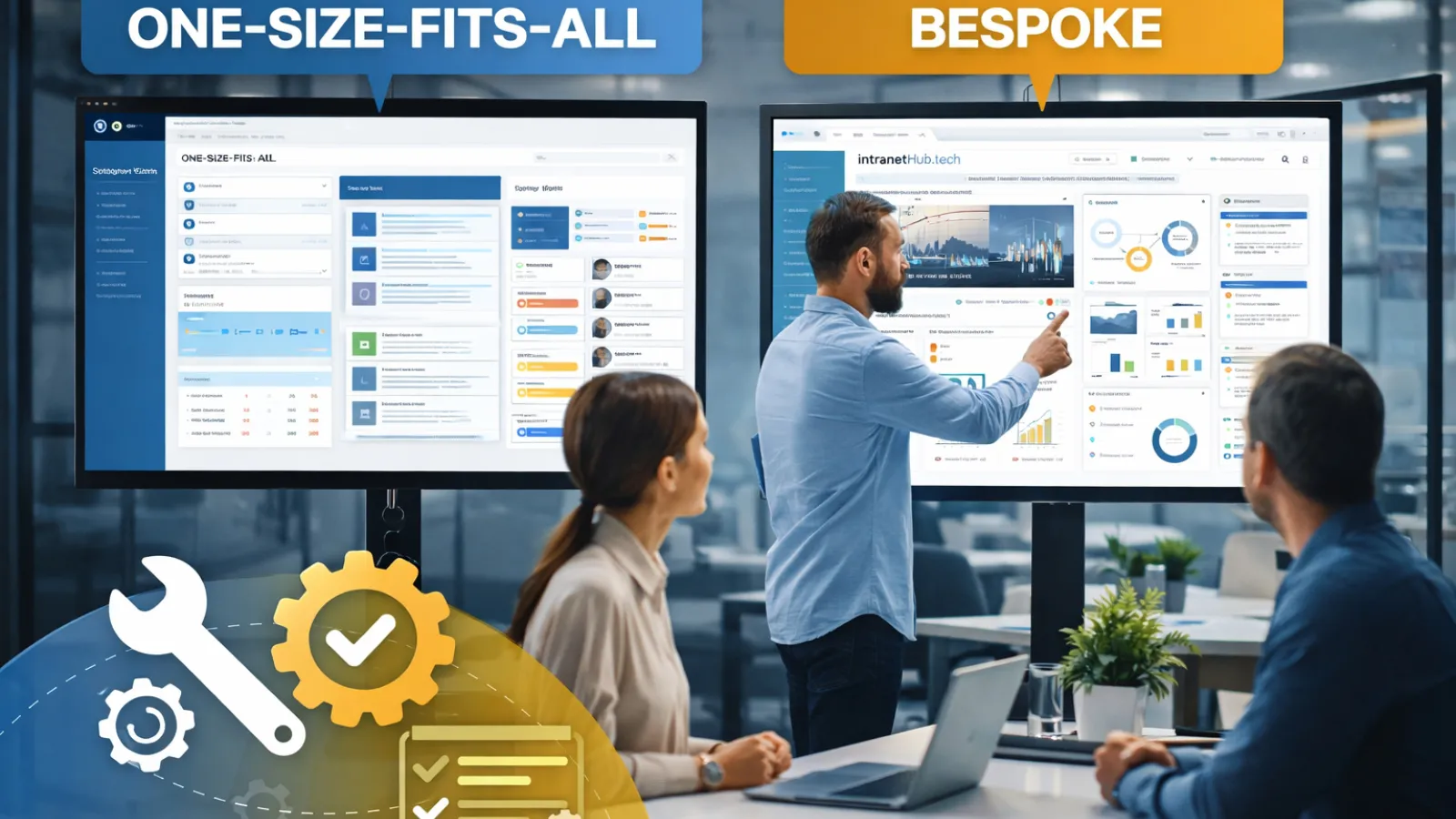

Bespoke Intranet: Why One-Size-Fits-All Simply Doesn't Cut It
Blog

Bespoke Intranet: Why One-Size-Fits-All Simply Doesn't Cut It

Introduction

Here's an honest question. When was the last time your employees actually opened your company intranet without being told to? If the answer is "rarely" or "never," the problem probably isn't your people. It's the platform.

Most organizations inherit an intranet that was built for a generic workforce. It sort of works, but it doesn't quite fit. Processes feel clunky, navigation is confusing, and the whole thing feels like it belongs to a different company entirely. A bespoke intranet fixes this at the root level.

In this guide, we'll break down exactly what a bespoke intranet is, who needs one, and what it takes to build something your team will genuinely rely on every single day.

What Is a Bespoke Intranet?

A bespoke intranet is a fully customized internal digital platform built specifically around your organization's structure, workflows, culture, and technology environment. The word "bespoke" comes from the tailoring world. It means made to measure, designed for one, built to fit perfectly.

Applied to intranet development, it means nothing is off-the-shelf. Every feature, every navigation flow, every integration, and every piece of the user experience is shaped around how your teams actually work. Not how a software vendor thinks teams should work.

What a Bespoke Intranet Typically Includes

  • A fully branded employee portal that reflects your company identity
  • Custom workflows and approval processes built around your operations
  • Role-based access so every employee sees what's relevant to them
  • Knowledge management systems organized around your content structure
  • Deep integrations with your specific HRMS, CRM, or ERP platforms
  • Custom dashboards for different departments and leadership levels
  • Mobile-first design for desk-based and field-based employees alike

Think of it less as software you buy and more as infrastructure you build. It belongs to your organization entirely.

Bespoke Intranet vs. Standard Intranet: The Real Difference

A lot of companies start with a standard intranet platform, SharePoint, Confluence, Happeo, or similar tools, and spend years trying to bend it into something that fits their needs. Sometimes it works. More often, it doesn't.

Here's an honest comparison of the two approaches:

FactorBespoke IntranetStandard Intranet Platform
Fit to Your WorkflowsBuilt exactly around your processesYou adapt your processes to the tool
Branding and IdentityFully on-brand, every detail controlledLimited to vendor templates
Integration DepthConnects to any system you needPre-built connectors, limited flexibility
ScalabilityGrows exactly the way your org growsMay hit platform ceilings
Long-term CostHigher upfront, lower total cost of ownershipLower upfront, ongoing licensing fees
User AdoptionDesigned for your people's habitsRequires your people to change habits
Security and ComplianceFull control over data architectureDependent on vendor infrastructure

The pattern is consistent. Standard platforms ask your organization to adapt. A bespoke intranet adapts to your organization. For companies with specific compliance requirements, complex workflows, or ambitious growth plans, the custom route almost always wins in the long run.

Key Features of a Bespoke Intranet Solution

The features that matter most in a bespoke intranet are the ones that solve your specific problems, not a generic list of capabilities. That said, most successful bespoke intranet solutions share a core set of capabilities:

Custom Employee Directory

Not just names and job titles. A bespoke directory can include skills, project history, department hierarchy, and availability. It becomes a genuine tool for finding the right person quickly across a large or distributed organization.

Tailored Content Management

Your intranet should organize information the way your company thinks, not the way a vendor's template does. A bespoke content architecture means policies live where employees expect them, documents are findable in seconds, and nothing goes stale because nobody owns it.

Department-Specific Dashboards

Different teams need different information front and center. A bespoke intranet lets HR, finance, sales, and operations each have a homepage that shows exactly what's relevant to them, with nothing extra cluttering the view.

Custom Workflows and Automations

Leave requests, expense approvals, onboarding checklists, document sign-offs. A bespoke intranet can automate these processes end-to-end rather than routing them through disconnected email chains.

Deep System Integrations

This is where bespoke development really earns its value. Your intranet connects directly to your payroll system, your CRM, your project management tools, your communication platforms. Everything talks to everything.

Advanced Search

Search that actually works. Bespoke intranets can be built with intelligent search that surfaces documents, people, policies, and announcements based on role, department, and behavior patterns.

Benefits of a Bespoke Intranet for Your Organization

Investing in a bespoke intranet isn't a small decision. But the case for it becomes clearer when you look at what it actually delivers:

Higher Employee Adoption

Generic intranets get ignored because they feel foreign. A bespoke intranet is built around familiar processes and your organization's language. Employees recognize it as theirs from day one, and adoption follows naturally.

Genuine Productivity Gains

When information is findable, processes are automated, and tools are connected, employees stop wasting time on friction. Studies consistently show that poor information management costs organizations hours of productivity per employee every week.

Stronger Internal Communication

A bespoke intranet lets you design communication flows that match your organization's structure. Leadership updates reach the right teams. Department news stays organized. Nothing important gets buried.

Better Compliance and Security

For regulated industries like finance, healthcare, or legal, data security isn't optional. A bespoke intranet gives you complete control over your data architecture, access controls, and audit trails. You're not relying on a vendor's infrastructure to protect sensitive information.

A Platform That Grows With You

Off-the-shelf platforms hit ceilings. A bespoke intranet is built to scale with your organization, adding features, users, and integrations as your needs evolve without being constrained by a vendor's product roadmap.

Who Actually Needs a Bespoke Intranet?

Not every organization needs to go fully bespoke from day one. But certain situations make it the obvious choice:

  • Regulated industries like banking, healthcare, or pharmaceuticals where compliance and data control are non-negotiable
  • Large or distributed organizations where one-size communication tools genuinely fail to serve everyone
  • Companies with complex workflows that standard platforms can't replicate without painful workarounds
  • Organizations with unique tech stacks where deep integrations are essential for the intranet to be useful
  • Businesses focused on employee experience that want a platform reflecting their culture, not a vendor's defaults
  • Fast-growing companies that need a platform built to scale rather than one they'll outgrow in two years

If your organization falls into any of these categories, a bespoke intranet development conversation is worth having sooner rather than later.

How to Build a Bespoke Intranet the Right Way

The process matters as much as the outcome. Here's how a well-executed bespoke intranet project typically unfolds:

Step 1: Run a Thorough Discovery Phase

Before anything gets designed or built, spend real time understanding your organization. Interview department heads and frontline employees. Map workflows. Audit your current tools. Document what works and what doesn't. This phase shapes everything that follows.

Step 2: Define Success Metrics Upfront

What does a successful intranet look like for your organization? Login frequency? Document retrieval time? Employee satisfaction scores? Defining these metrics before building ensures the final product is measured against real goals, not vague impressions.

Step 3: Involve End Users in the Design Process

The biggest predictor of intranet adoption is whether employees feel the platform was built for them. Bring real users into wireframe reviews, prototype testing, and feedback sessions. Their input prevents expensive mistakes and builds buy-in early.

Step 4: Choose the Right Technology Foundation

Drupal is a strong choice for bespoke intranet development due to its flexibility, robust access control, and strong security track record. Headless CMS architectures with modern React frontends are also increasingly popular for organizations that need high performance and a modern user experience. The right choice depends on your infrastructure and roadmap.

Step 5: Build in Agile Sprints

Agile development means your team sees working features every two to three weeks. Feedback loops stay short. Problems get caught early. And the final product reflects months of real input rather than a single big reveal at the end.

Step 6: Plan for Adoption Before Launch

Adoption strategy isn't a post-launch afterthought. Plan your internal communications, training sessions, and champion programs before the platform goes live. The goal is a full house on day one, not a slow trickle of reluctant users.

Step 7: Measure and Improve Continuously

Usage analytics tell you what's working and what isn't. Which sections get visited? Which features go untouched? Use this data to drive ongoing improvements and keep the platform relevant as your organization changes.

Common Mistakes to Avoid

Even well-resourced bespoke intranet projects can go sideways. Watch out for these:

  • Skipping discovery. Building without a deep understanding of your workflows guarantees a platform that doesn't quite fit, no matter how well it's coded.
  • Letting IT lead without HR and communications input. The people who manage information and culture need a seat at the table from day one.
  • Building too many features at once. Start with what your employees need most. Add complexity based on real usage data, not assumptions.
  • Ignoring mobile users. Remote workers and field teams are often the employees who need the intranet most. If it doesn't work on a phone, you've already lost them.
  • Treating launch as the end goal. The intranet needs ongoing ownership, governance, and improvement to stay valuable. Plan for this before you go live.
  • Choosing a development partner based on price alone. A cheap bespoke intranet that nobody uses is the most expensive option in the long run.

FAQs About Bespoke Intranet Solutions

What is the difference between a bespoke intranet and a custom intranet?

The terms are often used interchangeably, and in practice they mean very similar things. Both refer to an intranet built specifically for your organization rather than an off-the-shelf platform. "Bespoke" tends to emphasize the tailored, made-to-measure nature of the build, covering not just features but the entire user experience, workflows, and integrations.

How much does a bespoke intranet cost?

Costs vary significantly based on scope, integrations, and the development partner you choose. A focused starter build can range from $20,000 to $50,000. A full enterprise-grade bespoke intranet with deep integrations typically starts around $100,000 and scales from there. The total cost of ownership over three to five years is often lower than ongoing licensing fees for standard platforms, especially when adoption and productivity gains are factored in.

How long does it take to build a bespoke intranet?

A core feature set can go live in 10 to 14 weeks with a focused scope. A full enterprise bespoke intranet with multiple integrations and custom workflows typically takes 4 to 6 months. Timelines depend heavily on the complexity of your requirements and how quickly your team can participate in discovery and reviews.

What platform is best for bespoke intranet development?

Drupal is widely used for bespoke intranet development because of its flexibility, granular access control, and strong security architecture. It handles complex content structures and deep integrations well. React-based headless architectures are another strong option for organizations prioritizing modern UX and performance. The right choice depends on your existing systems and long-term goals.

Can a bespoke intranet integrate with our existing tools?

Absolutely. Deep, custom integrations are one of the defining advantages of a bespoke intranet. Whether your organization uses SAP, Workday, Salesforce, Jira, or a proprietary internal system, a well-built bespoke intranet can connect to it through APIs and create a genuinely unified experience for your employees.

How do we ensure high adoption after launch?

Adoption is a strategy, not a side effect. It starts during discovery when you involve real employees in the design process. It continues with a structured launch plan, training sessions, and internal champions who drive awareness across departments. Post-launch analytics then help you identify friction points and improve continuously. Organizations that treat adoption as an ongoing program consistently see stronger results than those that stop at launch day.

Conclusion

A bespoke intranet isn't just a technical project. It's a decision about how your organization wants to communicate, collaborate, and function at a fundamental level. When it's done right, it becomes infrastructure your teams rely on every single day without thinking twice about it.

The key is getting the process right. Start with discovery. Involve your people. Choose a development partner with real experience and a genuine interest in your success long after launch. Build in iterations. And treat adoption as the ongoing work it actually is.

Generic platforms will always be available for organizations that need something quick and cheap. But for organizations serious about employee experience, productivity, and long-term digital workplace strategy, bespoke is the only word that makes sense.

Ready to build a bespoke intranet your team will actually love? Reach out to Valuebound and let's start with a conversation about what your organization actually needs.

Download the Drupal Guide
Enter your email address to receive the guide.
get in touch