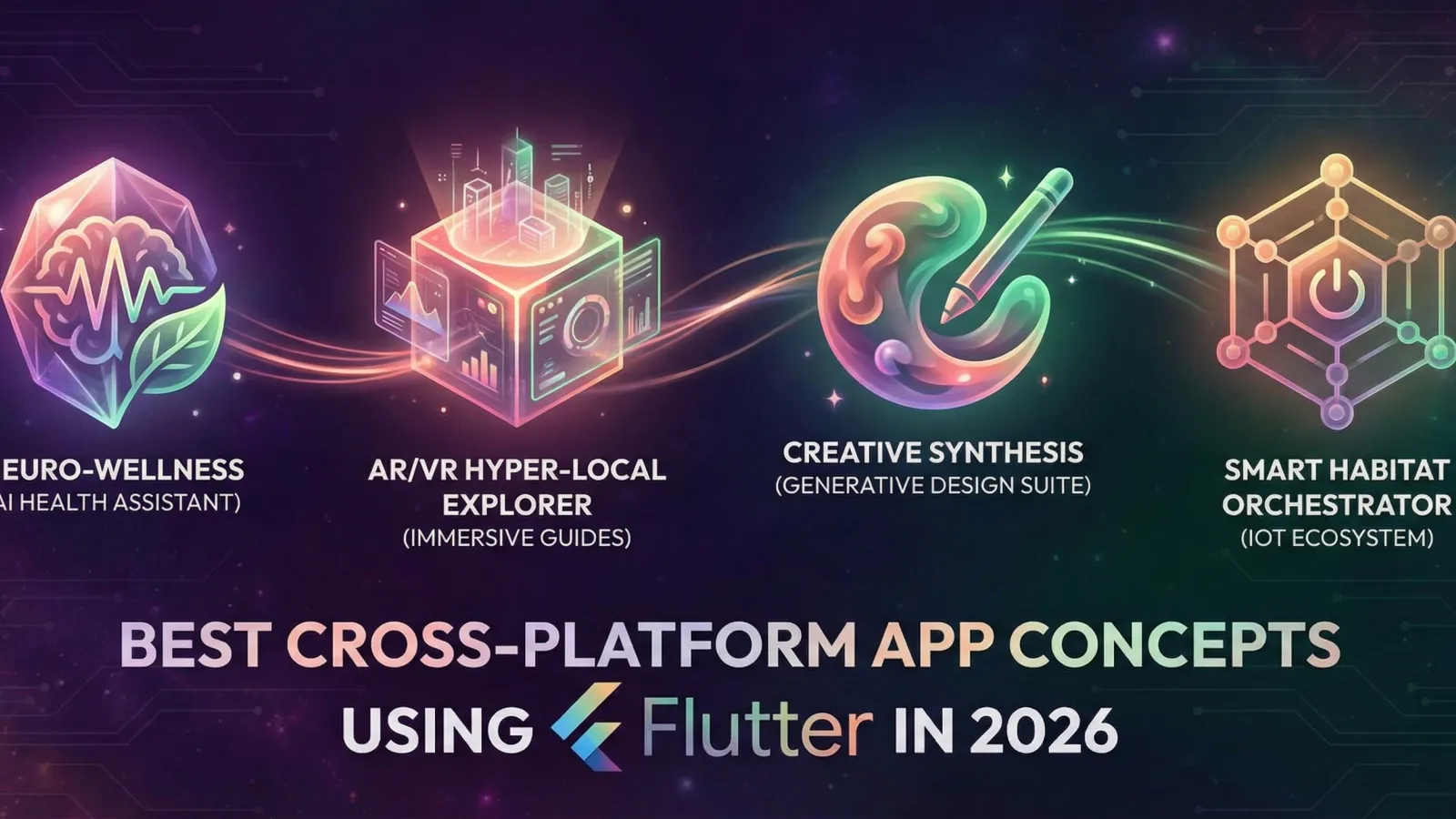

Write Once. Ship Everywhere. Mean It This Time.
There's a running joke in the software world: “write once, run anywhere” has been the developer's dream since Java promised it in 1995. Decades of broken promises later, Flutter actually delivers. And in 2026, that matters more than ever.
The premise is simple. Flutter, Google's open-source UI toolkit, lets developers write a single codebase and deploy it natively across iOS, Android, web, desktop (Windows, macOS, Linux), and even embedded systems. No rewrites. No diverging codebases. No platform-specific nightmares. Just one clean Dart codebase shipping .
As notes, Flutter's cross-platform model delivers cost savings of a figure that's transforming how founders, product teams, and enterprises think about mobile investment.
But this isn't a post about why Flutter is great. You've read that article. This is about what to build with it the cross-platform app concepts that are genuinely winning in 2026, and why Flutter is uniquely positioned to power each of them.
Let's get into it.
Why Flutter Leads the Cross-Platform Pack in 2026
Before the ideas, a quick moment of context. Flutter isn't the only cross-platform framework React Native, Xamarin, and Kotlin Multiplatform all exist. But Flutter's architecture makes it uniquely suited for building consistent, high-quality experiences across radically different platforms.
Unlike React Native, which bridges to native components (creating subtle inconsistencies across platforms), Flutter renders its own UI through its . That means what you see on iOS is pixel-identical to Android, web, and desktop. It's the difference between a translator and a native speaker.
According to , Flutter leads on four dimensions that matter commercially: UI consistency, performance parity across platforms, ecosystem maturity, and enterprise readiness. That's not marketing that's what shipping teams are experiencing.
Flutter vs. React Native vs. Native — Cross-Platform Snapshot
| Criterion | Flutter | React Native | Xamarin | Native (each) |
|---|---|---|---|---|
| Platforms | 6 (all) | Mobile + web | Mobile + desktop | 1 each |
| UI Consistency | Pixel-perfect | Near-consistent | Good | Perfect (per OS) |
| Performance | Near-native | Near-native | Good | Best |
| Cost Efficiency | 40–60% saved | 30–50% saved | 25–40% saved | Baseline |
| AI/ML Ready | ✅ Excellent | ✅ Good | ⚠️ Limited | ✅ Excellent |
| Enterprise Ready | ✅ Yes | ✅ Yes | ✅ Yes | ✅ Yes |
| MVP Speed | 2–6 weeks | 3–7 weeks | 4–8 weeks | 8–16 weeks |
The Best Cross-Platform App Concepts to Build with Flutter in 2026
These aren't abstract ideas. Each concept maps to a real market need, a proven monetization model, and a reason why Flutter's cross-platform nature is a specific, meaningful advantage for that category.
1. AI-Augmented Personal Finance Manager
The fintech space is being reshaped by AI and the opportunity for a cross-platform personal finance app that actually understands your money is enormous.
Imagine an app that connects to bank accounts, categorizes spending automatically using on-device ML, flags anomalies, predicts next month's budget shortfalls, and delivers all of this in a clean, consistent UI whether you're on your iPhone on the train, your Android tablet at home, or your browser at work.
Flutter is tailor-made for this. Its without compromise, and Firebase's real-time sync keeps data consistent across devices. Google Pay one of the proves that Flutter is production-ready for financial applications at global scale.
Platforms: iOS, Android, Web (desktop browser for deep analysis)
Flutter advantage: Consistent security UI across platforms; single auth flow; real-time sync
Monetization: Premium subscription ($8–$15/month) + financial product commissions
Key integrations: Plaid, Firebase, TensorFlow Lite (on-device categorization)
2. Telemedicine & Remote Health Monitoring Platform
Healthcare is undergoing a quiet revolution. Patients want care on their schedule, on their device. Doctors want tools that work whether they're on a hospital desktop or a mobile device between appointments.
A Flutter-built telemedicine platform that serves both audiences from one codebase is a genuinely compelling product.
Think video consultations, symptom tracking, medication reminders, wearable data integration, and AI-powered triage all running seamlessly from a single Flutter codebase. The web version serves healthcare providers on their workstations; the mobile app handles the patient experience. highlights healthcare as one of the verticals where Flutter's cross-platform consistency has the highest stakes because inconsistent UX in healthcare isn't just annoying, it's a safety issue.
Platforms: iOS, Android (patients) + Web (clinicians)
Flutter advantage: Shared business logic, consistent HIPAA-compliant UI, fast iteration
Monetization: B2B SaaS for clinics + patient subscription tier
Key integrations: Agora (video), Firebase, HealthKit/Google Fit, TensorFlow Lite
3. AR-Powered Retail & E-Commerce Experience
Try before you buy without leaving home. AR in retail isn't new, but Flutter has made building AR-powered shopping experiences dramatically more accessible.
A cross-platform Flutter app that lets users visualize furniture in their living room (web and mobile), try on glasses virtually, or see how a paint color looks on their walls and then purchase in-app is a conversion machine.
The cross-platform angle here is critical: desktop browsers drive discovery and consideration; mobile drives conversion. A Flutter app that handles both without diverging codebases means your AR experience is consistent and your conversion funnel is seamless. specifically identifies AR integration as one of Flutter's most commercially powerful emerging capabilities.
Platforms: iOS, Android, Web
Flutter advantage: ARKit/ARCore via Flutter plugins; consistent product visualization across platforms
Monetization: Commission on sales (5–15%) + white-label to retailers
Key integrations: ARKit, ARCore, Stripe, Firebase
4. Collaborative Project Management Tool (Notion Meets Trello)
The productivity software space is crowded, but there's a genuine gap: a cross-platform project management tool that's as capable on mobile as it is on desktop.
Most existing tools treat mobile as a second-class citizen stripped-down interfaces, missing features, awkward touch interactions.
Flutter changes this equation. Build once, and your kanban boards, Gantt charts, real-time collaboration, and document editing work equally well on an iPhone, an Android tablet, a MacBook, and a Windows workstation.
Platforms: iOS, Android, macOS, Windows, Web
Flutter advantage: Full feature parity across desktop and mobile; real-time sync via Firebase
Monetization: Freemium + team subscription ($12–$25/user/month)
Key integrations: Firebase Realtime Database, Google Drive API, Stripe
5. Hyperlocal Service Marketplace
Two-sided marketplaces connecting service providers with customers are perennial startup territory.
A Flutter marketplace that dramatically reduces the operational complexity of maintaining a two-sided platform.
eBay Motors another demonstrates that Flutter can handle the complexity of large marketplace applications without sacrificing performance or UI quality.
Platforms: iOS, Android (providers + customers) + Web (business dashboard)
Flutter advantage: One team, one codebase, three contexts dramatically reduced ops overhead
Monetization: Transaction commission (8–15%) + premium provider listings
Key integrations: Google Maps, Firebase, Stripe Connect, real-time notifications
6. Gamified Language & Skills Learning App
Duolingo didn't become a $7 billion company by accident. Gamified learning works.
A Flutter-built skills learning platform that works on mobile, web, and tablet can capture users across every context in which they learn.
Platforms: iOS, Android, Web (optionally macOS desktop)
Flutter advantage: Rich animation API; consistent gamified UX across all platforms
Monetization: Freemium + premium subscription ($9.99/month) + B2B corporate training
Key integrations: Firebase, audio players, in-app purchase, custom animation controllers
7. IoT Smart Home Control Hub
The smart home market is exploding and it's fragmented.
Flutter's emerging embedded platform support means you can envision a future where the same codebase controls the mobile app, the web dashboard, and even a custom wall-mounted display.
Platforms: iOS, Android, Web, macOS and potentially embedded displays
Flutter advantage: Consistent UI across all control surfaces; real-time updates via MQTT
Monetization: Hardware partnerships (revenue share) + premium automation subscription
Key integrations: MQTT, Bluetooth BLE, Firebase, Google Home/Apple HomeKit APIs
8. Mental Health & Mindfulness Companion
Burnout is a global epidemic. The mental health app market is projected to exceed $17 billion by 2030.
A Flutter-built mental wellness app removes a genuine friction point: users shouldn't have to switch devices to access a feature they need.
Platforms: iOS, Android, Web
Flutter advantage: Consistent calming UI; audio players; animated breathing exercises work across all platforms
Monetization: Freemium + premium ($7.99–$14.99/month) + B2B employee wellness packages
Key integrations: Firebase, audio players (just_audio), TensorFlow Lite (mood analysis)
9. Real-Time Supply Chain & Logistics Tracker
Enterprise buyers are increasingly open to Flutter.
A logistics tracking platform can serve warehouse staff on Android devices, fleet managers on web dashboards, and executives on iOS all from one codebase.
Platforms: Android (warehouse/drivers) + Web + iOS
Flutter advantage: Single codebase for radically different user contexts; real-time data sync
Monetization: B2B SaaS ($500–$5,000/month per client) + setup/integration fees
Key integrations: Google Maps, Firebase, barcode scanning, REST APIs, push notifications
Quick Comparison: All 9 Flutter App Concepts at a Glance
| App Concept | Platforms | Best For | Monetization | MVP Time |
|---|---|---|---|---|
| AI Finance Manager | Mobile + Web | Fintech startups | Subscription | 4–6 weeks |
| Telemedicine Platform | Mobile + Web | Health tech | B2B SaaS + Sub | 5–7 weeks |
| AR Retail App | Mobile + Web | E-commerce brands | Commission | 4–6 weeks |
| Project Management Tool | All 6 platforms | B2B SaaS | Freemium + Team sub | 5–8 weeks |
| Hyperlocal Marketplace | Mobile + Web | Service startups | Commission | 4–6 weeks |
| Gamified Learning App | Mobile + Web | Edtech founders | Freemium + B2B | 3–5 weeks |
| Smart Home Hub | Mobile + Web + Embedded | IoT startups | Hardware rev share | 6–10 weeks |
| Mental Wellness App | Mobile + Web | Consumer health | Freemium + Sub | 3–4 weeks |
| Logistics Tracker | Android + Web + iOS | Enterprise / B2B | B2B SaaS | 5–8 weeks |
What About the Learning Curve? (Dart Is Friendlier Than You Think)
Dart is Google's programming language that powers Flutter.
Most developers with JavaScript experience report being .
The Flutter SDK documentation is among the best in any ecosystem.
Enterprise-Ready: Flutter Isn't Just for Startups Anymore
In 2026, Flutter powers production applications at companies like Google, Alibaba, BMW, and eBay.
The enterprise case rests on three pillars. First, dramatically reduces cost. Second, means dashboards can share code. Third, Flutter's (Riverpod, Bloc) supports large codebases.
As shows, enterprise adoption is accelerating.
Frequently Asked Questions
What platforms does Flutter support?
Flutter supports : iOS, Android, Web, Windows, macOS, and Linux.
How much cost can Flutter save?
Flutter typically delivers compared to separate native apps.
What's the biggest trend right now?
Without question, it's .
How steep is the learning curve?
Dart is typically learnable to .
What are the most successful real-world apps?
Google Pay, eBay Motors, Alibaba's Xianyu, BMW's iDrive app, Groupon.
How fast can you build an MVP?
A Flutter MVP can realistically launch in .
What monetization models work best?
Subscriptions, freemium, advertising, B2B SaaS, marketplace commissions.
How does Flutter perform on web?
Flutter web delivers .
Is Flutter enterprise-ready?
Yes - unambiguously.
How does Flutter compare to React Native?
Flutter's key advantage is .
Conclusion: The Platform Is Ready. Are You?
The technology has caught up to the promise.
The concepts in this guide aren't theoretical. They're being built right now.
The frameworks are mature. The market demand is real. The cost savings are documented.
What's left is the decision to start building.
"The best cross-platform app isn't the one that works on the most platforms. It's the one that works brilliantly on all of them - and Flutter is the only framework that consistently delivers that in 2026."
Now pick your concept. Open your editor. Ship something worth using
