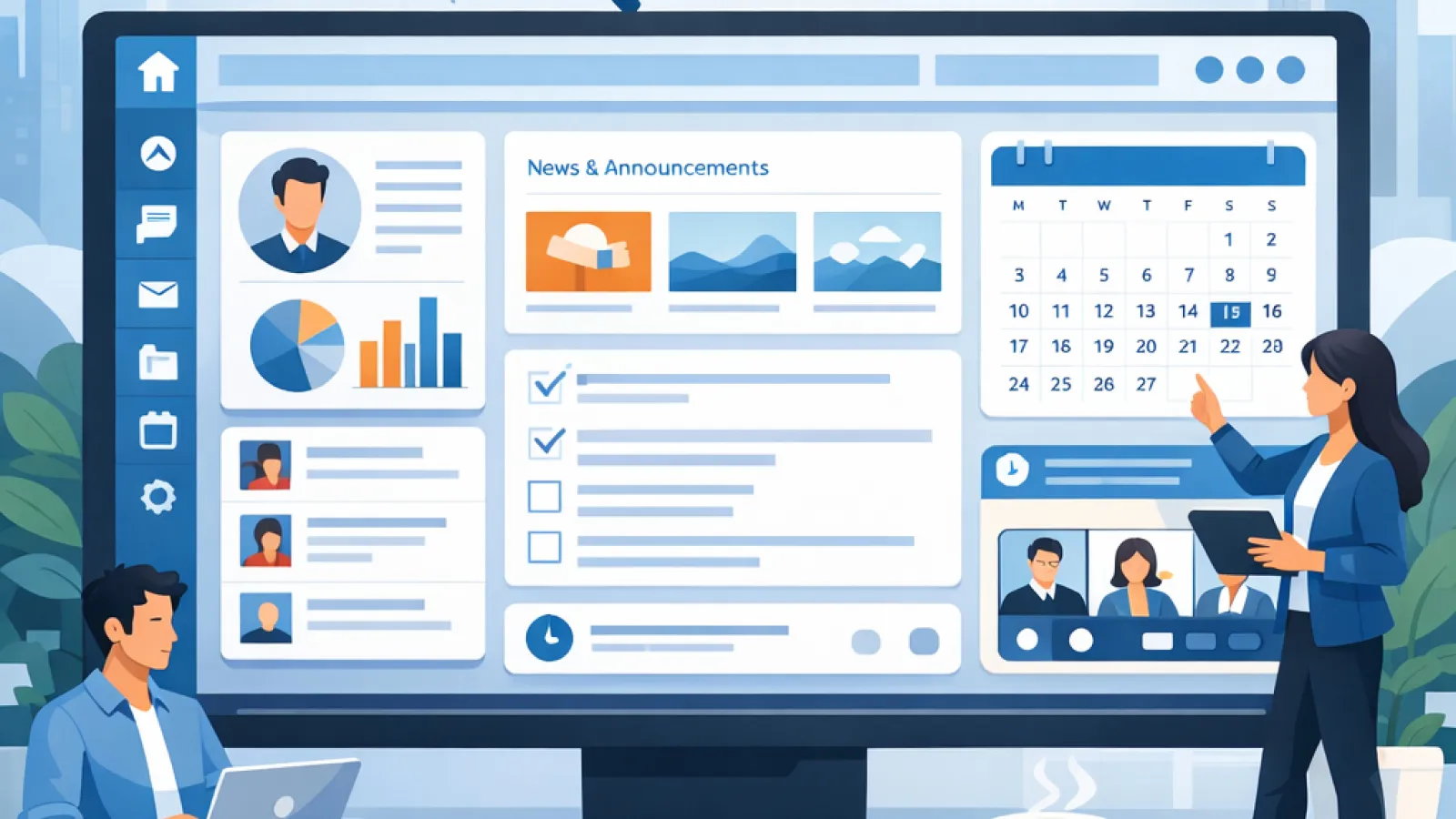

Only 13 percent of employees use their company's corporate intranet portal on a daily basis. Nearly a third of the workforce never logs in at all.
Organizations have spent millions implementing these platforms, customizing dashboards, publishing news feeds and building document libraries, and the result is a platform that functions, for most of its intended users, as a digital graveyard for outdated HR PDFs and unread executive newsletters.
The disconnect between what enterprise software vendors are selling and how modern employees actually work has never been wider. Understanding why requires looking past the standard feature conversation and into the architectural shifts that are quietly redefining what a corporate intranet portal actually is.
What the Industry Has Agreed On and Why It Is Not Working
The mainstream conversation about corporate intranet portals in 2026 reflects a clear vendor consensus on what the platform should include.
Personalized dashboards that adapt based on department, seniority and location. Robust document management for policies, procedures and templates. Mobile-first accessibility ensuring deskless workers have the same access as desk-bound colleagues. Social and gamification features including peer recognition feeds, interactive polls, digital shout-outs and comment sections designed to mirror the experience of consumer social media platforms.
These features are genuinely useful as a baseline. They provide incremental improvements to corporate communication and establish a minimum standard of information access across a distributed workforce.
The problem is not that they are wrong. The problem is the premise they all share.
Standard Portal Feature vs Reality
| Standard Portal Feature | What Vendors Claim | The Actual Limitation |
|---|---|---|
| Personalized dashboard | Adapts content to role and location | Still requires employees to leave their primary work environment to visit it |
| Unified keyword search | Single bar pulls documents across the platform | Relies on users guessing exact document titles buried in nested folders |
| Social recognition feeds | Peer shout-outs and polls drive engagement | Engagement is driven by social habit, not by the portal solving a real work need |
| Mobile accessibility | Deskless workers access announcements from any device | Access does not equal use if the content is not relevant or timely |
| Document management | Central repository for policies and procedures | Static documents do not answer specific questions from specific employees |
Every one of these features operates on the same foundational assumption: that employees will stop their actual work, leave their primary software environment and actively navigate to a separate platform.
In 2026, that assumption is what the usage data is rejecting. The corporate intranet portal that requires an active visit to deliver value is structurally competing against every other tool in the employee's digital environment, and it is losing.
The Headless Intranet Meets Employees Where They Already Are
The most significant architectural shift happening in corporate intranet portal design is the one that most evaluations never discuss.
The headless intranet divorces the backend content infrastructure from the frontend interface entirely, and the result is a platform employees interact with constantly without ever visiting a dedicated URL.
In a headless architecture, internal communications teams still use a central content management system to publish news, update policies and manage organizational directories. But employees never navigate to an intranet homepage.
Instead, the corporate intranet portal functions as a sophisticated API layer that injects content directly into the applications where employees already spend their working hours. If a team spends eight hours a day in Microsoft Teams or Slack or Salesforce, critical announcements, mandatory compliance forms, cultural updates and relevant knowledge arrive inside those specific environments at the moment they are needed.
The intranet comes to the employee rather than waiting for the employee to come to it.
This is not a minor UX improvement. It is a fundamental rethinking of where the corporate intranet portal lives in the employee's daily experience.
The platforms achieving the highest actual engagement rates in 2026 are the ones employees interact with without realizing they are interacting with an intranet. The content appears where the work is happening. The visit never needs to occur.
Valuebound builds corporate intranet portals with headless API architecture as a foundation rather than a feature upgrade, ensuring content reaches employees inside their actual work tools rather than asking them to add another destination to their digital day. Visit valuebound.com to explore what that design approach looks like in practice.
RAG Replaces the Search Bar as the Enterprise Oracle
Keyword search is the most praised and most fundamentally broken feature in the standard corporate intranet portal conversation. Every major vendor highlights unified search as a core capability.
What unified keyword search actually delivers is a list of documents whose titles partially match the words an employee typed, ranked by metadata rather than relevance to the actual question being asked.
The problem is structural. Keyword search requires the employee to know the name of the document they are looking for. It returns results based on word matching rather than intent understanding.
When the answer to a real work question is buried on page 23 of a 40-page policy PDF, keyword search finds the document but does not find the answer. The employee still has to read the document.
Retrieval-Augmented Generation changes this entirely. RAG grounds a large language model securely within the company's proprietary data, turning the corporate intranet portal from a filing cabinet into what practitioners are calling an enterprise oracle.
An employee does not search for the corporate travel policy. They type a direct question: can I expense business-class travel to London next week?
The system synthesizes the relevant policy sections, checks the employee's seniority tier against the applicable rules, and returns a direct answer with a generated citation pointing to the source. Time-to-knowledge drops from several minutes of document navigation to milliseconds of synthesized response.
The security architecture behind RAG deployment matters as much as the capability itself. The language model only has access to data the querying employee is authorized to see. The proprietary data never leaves the enterprise environment.
The oracle answers questions using internal knowledge without exposing that knowledge to external systems. This combination of conversational intelligence and enterprise-grade data governance is what separates the next generation of corporate intranet portals from the keyword search systems that still dominate most current implementations.
The Algorithmic Talent Marketplace Replaces the Static Directory
The employee directory is the most consistently underbuilt feature in every corporate intranet portal evaluation.
Standard implementations offer a searchable page of headshots, job titles, department affiliations and contact details. This is a digitized phone book. It has not meaningfully evolved in two decades of intranet development.
Directory Model Comparison
| Directory Model | What It Shows | What It Cannot Do |
|---|---|---|
| Static directory | Name, title, department, contact details | Cannot surface skills not listed in the HR profile |
| Profile-based directory | Self-declared skills and project history | Depends entirely on employees keeping profiles current |
| Algorithmic skills ontology | Dynamically built from digital work footprint | Requires behavioral data integration across work tools |
Advanced corporate intranet portals are replacing the static directory with a continuously updated skills ontology built from each employee's actual digital behavior.
The types of documents an employee authors, the code they commit, the projects they contribute to, the certifications they complete and the topics they engage with all feed a dynamic profile that reflects real capability rather than a job title. The system does not wait for employees to update their profiles. It observes and infers continuously.
The practical application is an algorithmic talent marketplace that actively matches internal capability to organizational need.
When a cross-functional project requires a French-speaking product manager with mobile deployment experience, the corporate intranet portal surfaces exact internal candidates rather than requiring a manager to rely on personal network knowledge or post an internal job listing and wait.
Internal gig-work matching, targeted mentorship connections and cross-departmental skill transfer all become operationally feasible when the platform knows what the workforce can actually do rather than what HR records say their role is.
This capability matters most for retention. Employees who can see internal mobility opportunities matched to their demonstrated skills are significantly less likely to look externally for the growth they cannot find inside the organization.
The corporate intranet portal in this model is not just a communication tool. It is a talent infrastructure that makes the organization's existing human capital visible to itself.
Frequently Asked Questions
Why do most corporate intranet portal implementations fail to achieve meaningful daily usage?
The primary cause is a design premise that requires employees to actively leave their primary work environment to visit a separate platform.
When an employee spends most of their working day in communication and productivity tools like Slack, Teams or Salesforce, a corporate intranet portal that exists as a separate destination competes against every other tool for a finite amount of attention and rarely wins.
Platforms that address this through headless API architecture, pushing content directly into the tools employees already use, consistently achieve higher sustained engagement because they eliminate the visit requirement entirely.
What is a headless corporate intranet portal and how is it different from a standard implementation?
A headless corporate intranet portal separates the backend content management infrastructure from the frontend interface.
Internal teams manage content, policies and communications through a central system, but employees never navigate to a dedicated intranet URL.
Instead, the platform delivers content through APIs into the applications where work is actually happening. The result is that employees receive announcements, compliance updates and relevant knowledge inside Microsoft Teams, Slack or their primary project management tool without needing to add another destination to their daily digital workflow.
How does Retrieval-Augmented Generation improve the corporate intranet portal search experience?
RAG replaces keyword matching with intent-based question answering by grounding a large language model within the organization's proprietary document and policy data.
Instead of searching for a document title and reading through pages to find a relevant paragraph, an employee types a direct question in natural language and receives a synthesized answer with a citation pointing to the source.
The language model only accesses data the querying employee is authorized to see, and the proprietary information never leaves the enterprise environment.
Time-to-knowledge drops from minutes of document navigation to near-instant synthesized responses.
What is a skills ontology and why does it matter for a corporate intranet portal?
A skills ontology is a dynamically maintained map of organizational capability built from employees' actual digital work behavior rather than self-declared profiles or HR job titles.
The corporate intranet portal builds this map by analyzing the documents employees author, the projects they contribute to, the code they write and the topics they engage with across connected work tools.
The resulting picture of organizational capability is more accurate and more current than any static directory.
It enables the portal to function as an algorithmic talent marketplace, actively matching internal candidates to project needs, mentorship opportunities and internal mobility paths in real time.
Conclusion
The corporate intranet portal that organizations need in 2026 does not ask employees to visit it.
It delivers intelligence directly into the flow of work through headless API architecture. It answers specific questions through RAG rather than returning document lists through keyword search.
It maps real organizational capability through behavioral analysis rather than maintaining a static directory of job titles. And it uses that capability map to actively connect talent to opportunity rather than waiting for employees to discover internal mobility through personal networks.
The technology to build all of this exists. The gap is in recognizing that the destination-based intranet model has already been replaced in the organizations achieving the highest engagement and the highest internal knowledge utilization.
Visit valuebound.com to learn how Valuebound designs corporate intranet portals around headless delivery architecture, RAG-powered enterprise intelligence and dynamic talent marketplace capability built for organizations that need their internal platform to work as hard as their external-facing technology.
