
Organizations are losing $8.8 trillion annually to employee disengagement. That represents nearly 9 percent of global GDP.
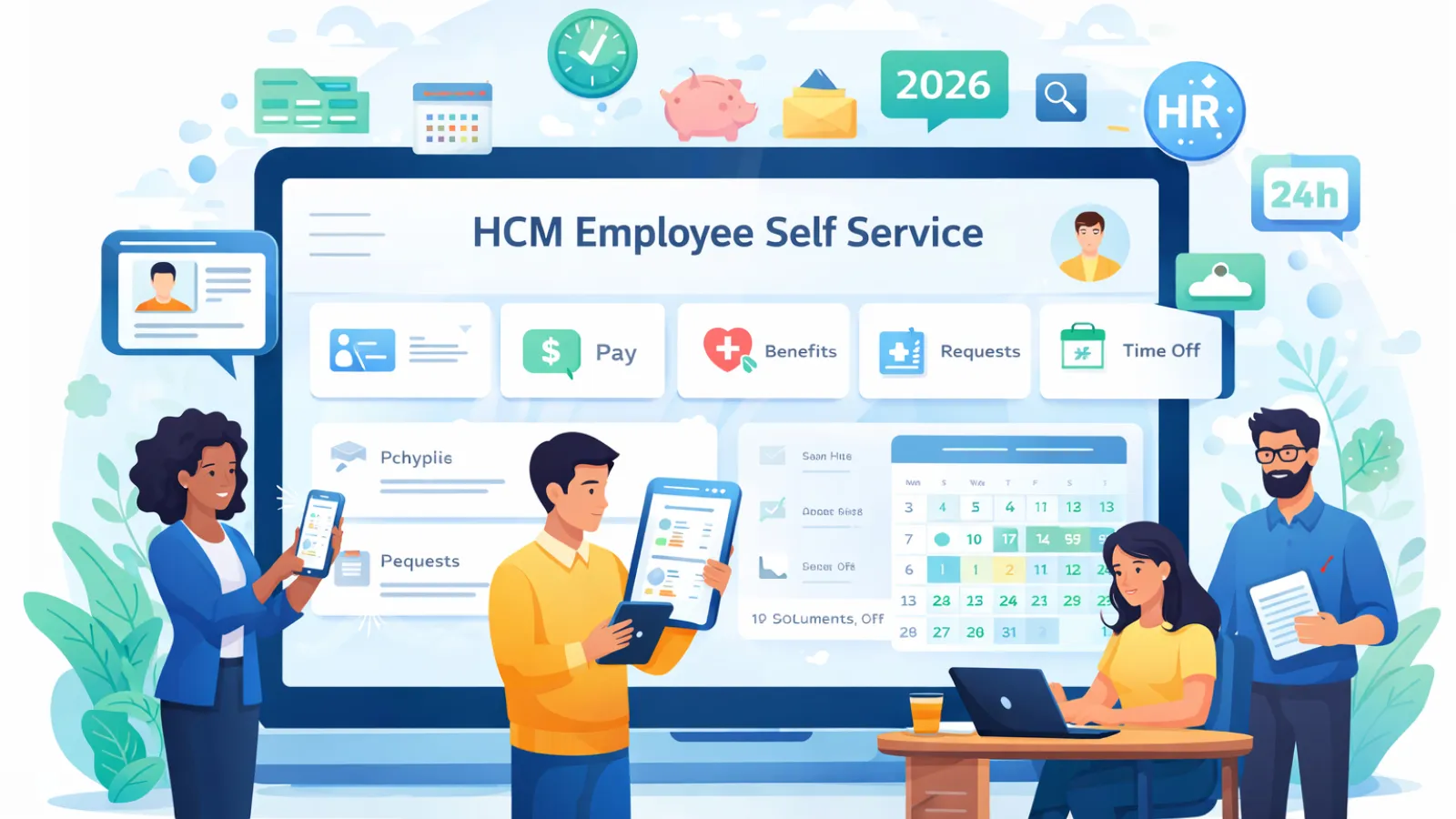
At the center of most solutions sits the HCM employee self-service portal. It has replaced many human interactions in the workplace and become the primary interface between employees and organizations.
The industry presents this as progress. The research shows a more complex reality.
What Modern ESS Portals Are Built to Do
The shift from basic HRIS to full HCM platforms expanded the role of employee self-service significantly.
Modern systems manage the entire employee lifecycle, from hiring to development and exit. Cloud architecture enables real-time updates across payroll, benefits, and IT systems through a single source of truth.
Employees can access services anytime, from any device. This has transformed ESS from a back-office tool into a daily interaction layer.
Core ESS functionalities
| Module Category | Key Functions | Organizational Benefit |
|---|---|---|
| Financial Wellness | Payslips, tax forms, direct deposit updates | Reduces payroll queries |
| Benefits Administration | Enrollment, life events, retirement plans | Simplifies benefits management |
| Time and Attendance | PTO tracking, shift swaps, clock-in systems | Improves compliance |
| Lifecycle Management | Onboarding, e-signatures, feedback tools | Reduces onboarding time |
The cost advantage is clear. A manual HR task costs around $4.86, while accessing information through a portal costs almost nothing.
However, this calculation ignores several hidden costs.
The Deskless Workforce Gap
Around 80 percent of the global workforce is deskless. Many of these employees do not have corporate email or direct access to ESS platforms.
Instead of eliminating manual work, organizations often shift it to supervisors.
This creates a hidden administrative burden. Managers handle employee requests manually, consuming time that is rarely accounted for in ROI calculations.
The impact goes beyond cost. Employees may miss critical updates or fail to resolve issues due to limited access.
Organizations that address this with mobile-first access, biometric login, and simplified interfaces report better communication and compliance outcomes.
Dehumanization and Employee Experience
Digital systems often remove human interaction from sensitive HR processes.
When employees handle benefits issues, leave requests, or disciplinary actions through rigid interfaces, the experience can feel impersonal.
This leads to what researchers describe as mechanistic dehumanization.
Employees experiencing this are more likely to disengage, reduce effort, and withhold valuable knowledge. The intended efficiency of ESS can unintentionally reduce trust and engagement.
The solution is not to remove technology, but to design it with human touchpoints where empathy is required.
Valuebound builds HCM employee self-service platforms that balance automation with human interaction. Visit valuebound.com to learn more.
The Friction Cost Paradox
Traditional ROI models focus on time saved for HR teams. They rarely consider the cost transferred to employees.
This is known as friction cost.
Employees in structured roles cannot easily absorb administrative tasks. For them, time spent navigating portals directly impacts productivity.
Friction impact by role
| Role Type | Self-Paced Work Capacity | ESS Impact |
|---|---|---|
| Management | High | Minimal disruption |
| Business Roles | Moderate | Distributed impact |
| Production | Low | Direct productivity loss |
| Healthcare Support | Very low | Critical disruption |
For roles with little flexibility, even small interruptions can affect operational outcomes.
Organizations that ignore this cost risk overstating the benefits of ESS.
AI, Privacy and Trust Risks
AI is becoming a core part of HCM employee self-service platforms.
While it enables automation and insights, it also introduces new risks.
Some systems use behavioral analytics and predictive models that monitor employee activity. Even when compliant with regulations, these tools can create a sense of surveillance.
Employees may feel pressure to perform in ways that align with algorithmic expectations.
At the same time, rigid enterprise systems push employees toward external tools. Many use public AI platforms for convenience, sometimes exposing sensitive data unknowingly.
Organizations must ensure that AI features provide clear value to employees and maintain transparency in how data is used.
The HR Burnout Reality
HR teams are under increasing pressure.
Most HR leaders report feeling overwhelmed, with many experiencing burnout. The shift toward digital systems has not always reduced workload. In some cases, it has increased complexity.
HR professionals often spend more time managing systems than supporting people.
Budget constraints further complicate this, forcing organizations to prioritize efficiency over experience.
Successful organizations focus on stabilizing systems and improving adoption rather than continuously adding new features.
Frequently Asked Questions
What is HCM employee self-service?
It is a platform that allows employees to manage HR-related tasks such as payroll, benefits, and time tracking without direct HR involvement. It extends traditional HR systems into a more interactive and accessible experience.
Why do ESS portals fail to deliver ROI?
Most ROI models only measure HR efficiency and ignore employee friction. They also overlook challenges faced by deskless workers and underestimate adoption barriers.
How does dehumanization affect ESS adoption?
When employees interact only with systems during important moments, they may feel disconnected. This reduces engagement and trust in the platform.
What risks come with AI in ESS platforms?
AI can create privacy concerns and increase surveillance pressure. Organizations must ensure transparency and focus on employee value rather than just data collection.
Conclusion: What ESS Needs to Get Right
HCM employee self-service platforms are critical to modern workforce management.
However, their success depends on more than efficiency.
They must address the needs of deskless workers, reduce friction for all roles, maintain human connection, and build trust in AI systems.
The technology exists to achieve this. The challenge lies in designing systems that balance efficiency with human experience.
Visit valuebound.com to explore how Valuebound builds HCM employee self-service platforms focused on real usability, trust, and workforce-wide impact.
