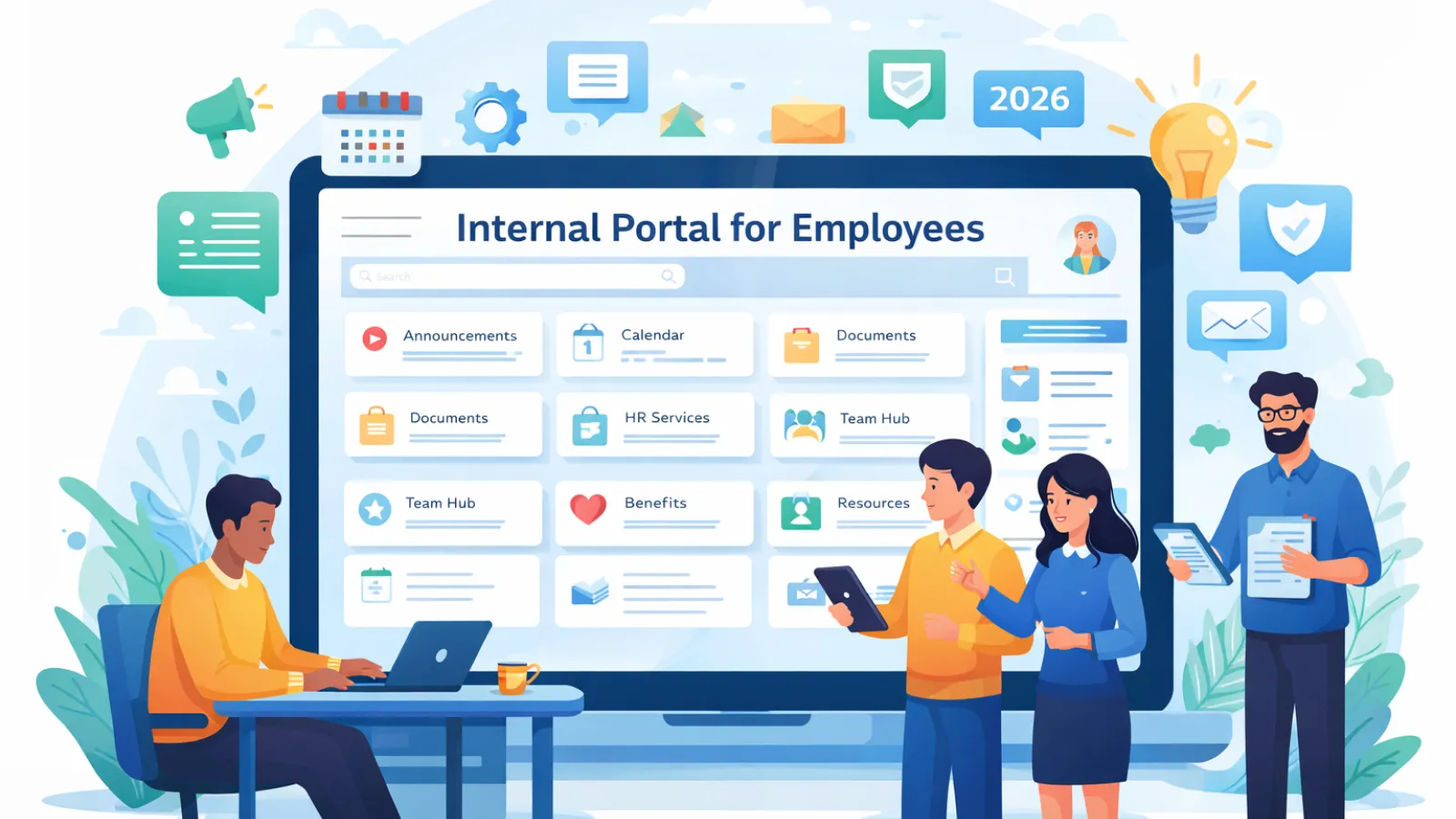

The global employee experience management market has reached $7.1 billion in 2026. Organizations have spent heavily on digital workplace tools, AI integrations, and portal upgrades.
Yet most internal portals for employees are now more cluttered and harder to navigate than before. The number of tools has increased, but the signal-to-noise ratio has worsened even faster.
The gap between what these platforms promise and what employees actually experience is where the real problem lies.
What the Modern Baseline Looks Like
The standard for an internal portal for employees has evolved significantly.
Universal self-service is now expected. Employees want to handle HR requests, IT tickets, and administrative tasks without human intervention.
Semantic search has replaced keyword search. Employees expect direct answers instead of being sent to long documents.
Hyper-personalization ensures that each employee sees relevant content based on their role, location, and stage in the organization. A one-size-fits-all homepage is no longer acceptable.
These capabilities are no longer differentiators. They are the minimum requirement. The real challenge lies in managing the complexity they introduce.
The Workslop Problem and Content Overload
A new issue has emerged with the rise of AI-generated content. Researchers describe it as workslop.
Workslop is the accumulation of low-quality or redundant content created by multiple teams using AI without governance. Over time, this fills the portal with conflicting or outdated information.
Employees searching for answers often find multiple versions of the same policy with no clear indication of which is correct. This erodes trust and pushes them to rely on email or informal channels instead.
The solution is a shift from content creation to content management. Leading organizations focus on filtering, verifying, and archiving information instead of continuously adding more.
Key gap areas
| Gap Area | Current Problem | Leading Approach |
|---|---|---|
| Content overload | Multiple unverified versions of information | Active content governance and archiving |
| Cultural disconnect | Low engagement despite constant updates | Real-time social and recognition features |
| AI limitations | Manual navigation still required | Task automation through AI agents |
| Data accumulation | Excess unused data | Automated cleanup and lifecycle management |
Valuebound builds internal portals for employees with strong governance models that prevent content overload before it starts. Visit valuebound.com to learn more.
The Agentic Shift in Digital Workplaces
Most portals still operate on a navigation-based model. Employees search, read, and act manually.
This model is changing.
In an agentic system, employees express intent and the system executes tasks automatically. For example, instead of navigating multiple steps to request leave, an employee simply states the request and the system completes it.
This shift transforms the internal portal for employees from a destination into an execution layer.
Organizations that design for this interaction model are seeing better returns from their digital workplace investments.
Cultural Connection and Digital Experience
Remote and hybrid work have reduced opportunities for natural interaction.
The internal portal for employees is now one of the primary spaces where organizational culture is experienced.
Most portals are not designed for this. They focus on information delivery rather than human connection.
This creates what can be described as cultural debt. Employees feel disconnected even when they have access to all necessary information.
Leading organizations are addressing this by integrating social features directly into the portal. These include recognition feeds, community spaces, and real-time interaction formats.
This approach transforms the portal into a place for connection, not just communication.
The Hidden Sustainability Issue
Internal portals store large volumes of unused data over time.
This includes outdated documents, duplicate files, and irrelevant content. This type of data is often referred to as redundant, obsolete, and trivial data.
The impact goes beyond performance. Storing unnecessary data increases infrastructure costs and energy consumption.
Organizations are now addressing this through automated data lifecycle management and regular audits.
A cleaner portal improves performance, reduces costs, and supports sustainability goals.
Frequently Asked Questions
What should an internal portal for employees do in 2026?
It should provide self-service functionality, intelligent search, and personalized experiences. Beyond that, it must manage content quality, support automation through AI, and enable meaningful employee interaction.
Why do employees stop using internal portals?
The main reason is loss of trust in information. When employees encounter outdated or conflicting content, they stop relying on the portal. Lack of engagement features also reduces repeat usage.
What is cultural debt in digital workplaces?
Cultural debt refers to the growing disconnect employees feel in the absence of meaningful interaction. Portals that focus only on information delivery contribute to this issue.
What is redundant, obsolete, and trivial data?
It refers to unused or outdated data that accumulates over time. This reduces system efficiency and increases operational costs.
Conclusion: What Makes Portals Work in 2026
The internal portal for employees is evolving into a smarter and more focused system.
Successful platforms reduce noise instead of adding to it. They automate tasks instead of requiring navigation. They enable connection instead of just delivering content.
They also maintain quality through strong governance and continuous updates.
The technology already exists. The difference lies in how organizations choose to design and manage their portals.
Visit valuebound.com to explore how Valuebound builds internal portals for employees that prioritize clarity, automation, and meaningful employee experience.
