
Meta Description: Intranet software cost goes far beyond the license fee. Here is the complete cost breakdown enterprise buyers need before they budget, negotiate, or sign anything.
The most common budget mistake in enterprise technology is treating the license fee as the project cost. With intranet software cost, this mistake is particularly expensive. Organizations that budget based on per-seat pricing alone routinely find themselves 40 to 60 percent over budget before the platform goes live.
Intranet software cost has four distinct layers: licensing, implementation, ongoing operations, and the governance work that determines whether employees actually use what you bought. Most vendor quotes cover only the first layer. The others are real, predictable, and large enough to derail an approval if they surface during implementation rather than during planning.
This article breaks down every cost layer with specific numbers, explains why the cost picture shifts dramatically based on organization size, and gives enterprise buyers the complete picture needed to build a budget that survives contact with implementation reality.
Why Most Intranet Budgets Fall Short
Intranet projects get approved on the license number. They get delivered on the full project number. The gap between those two figures is where most budget surprises live. Buyers present a per-seat fee to finance, get approval, and then discover during scoping that the platform they chose requires custom integration work, content migration services, and a change management program that were never in the original figure.
This is not accidental. Most SaaS vendors present the most attractive number at the top of the funnel. The implementation scope comes later, by which point the platform decision has already been made. Understanding the full intranet software cost picture before the shortlist is finalized is the only way to avoid this sequence.
The License Fee: What the Quote Actually Covers
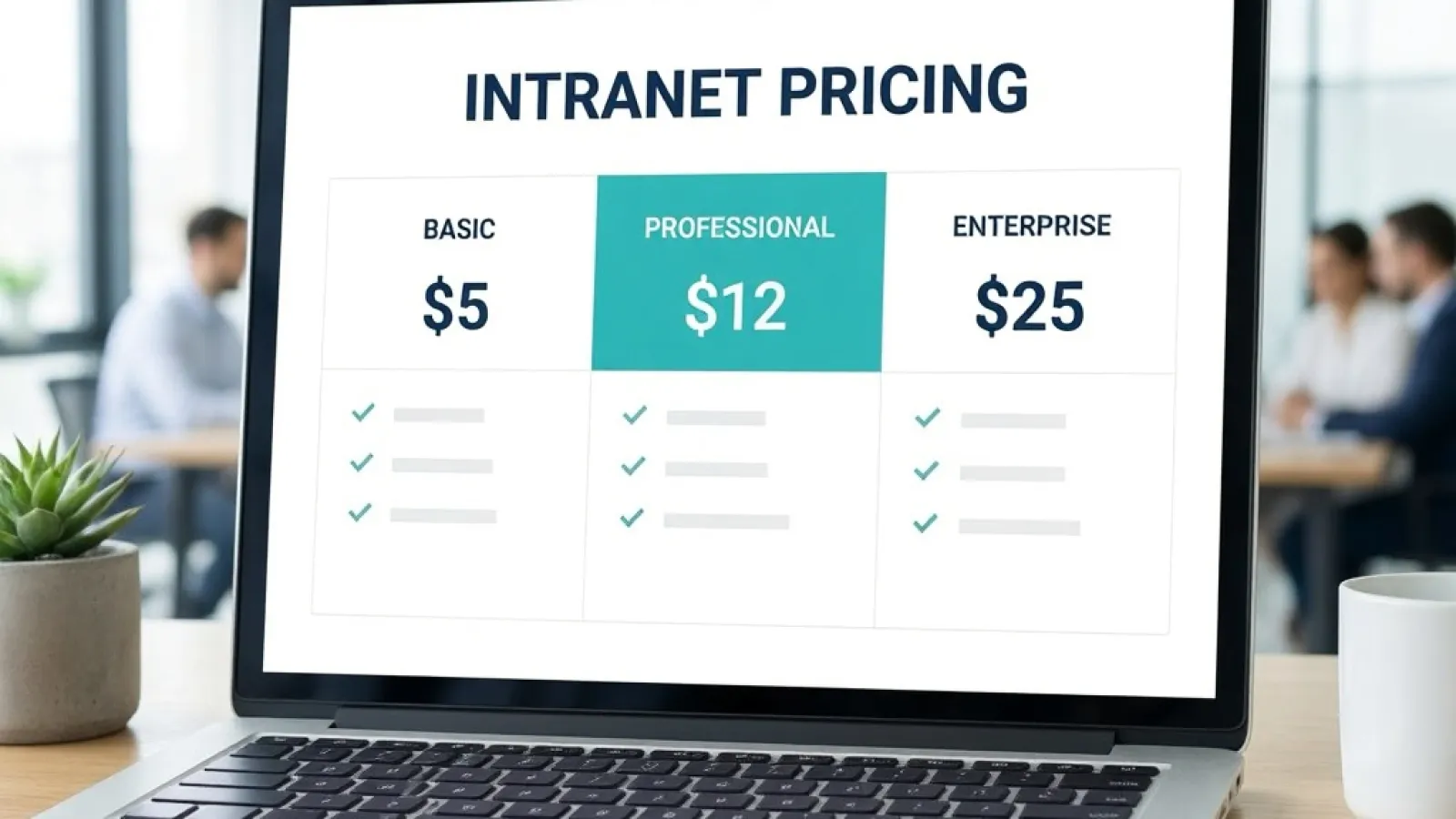
SaaS intranet platforms charge on a per-user, per-month basis. Standard ranges in 2026 sit between $5 and $30 per user per month depending on the feature tier. At those numbers, annual license costs look like this across organization sizes:
A 500-person organization at $15 per user per month pays $90,000 annually in licensing. At 2,000 employees, that same rate produces $360,000 annually. At 5,000 employees it reaches $900,000. These are license-only numbers. Nothing else is included.
Feature tiering is where the license cost grows past the initial quote. Most enterprise intranet vendors structure their tiers so that capabilities you actually need , AI-powered search, advanced analytics, API access for integrations, SSO — sit one tier above the base price. Buyers who shortlist based on the entry-level rate consistently find themselves purchasing the next tier up once scoping begins.
The Hidden Cost Stack Every Enterprise Buyer Misses
Four budget categories sit outside the license fee and outside most vendor quotes. Each one is predictable. None of them are small.
Content Migration
Moving content from a legacy intranet, SharePoint environment, or distributed file system into a new platform is time-intensive and technically complex. Content migration regularly accounts for 15 to 25 percent of total intranet project budgets. For a 2,000-person organization, that can mean $50,000 to $100,000 in migration costs alone, before any integration or configuration work begins.
Integration Development
Every intranet vendor publishes a connector list. Connectors are not the same as integrations. A connector establishes a basic data link. A genuine enterprise integration one that surfaces real-time HR data, syncs with your project management environment, and handles your specific system versions and data volumes requires custom development work. Integration development typically adds 10 to 15 percent to total project cost. For complex environments with multiple enterprise systems, it frequently exceeds that range.
Change Management and Training
This is the most consistently underfunded category in intranet budgets. Organizations that treat change management as an announcement email and a one-hour training session report significantly lower adoption at 12 months. Real change management means restructuring how departments own and publish information, running phased adoption programs by business unit, and maintaining active communication about the platform for six months post-launch. Properly scoped, change management adds 10 to 20 percent of project cost. Skipping it does not save money. It produces a platform that employees ignore.
Post-Launch Governance and Operations
An intranet is not a project. It is an ongoing product. Content becomes stale within months without active governance. Platform administrators require training as vendor updates arrive. Analytics need to be reviewed and acted on to sustain adoption. Annual post-launch operations typically run 20 to 30 percent of the original license cost on top of the recurring subscription. Organizations that do not budget for this phase discover it when adoption metrics drop in year two.
If your organization is building a cost model for an intranet investment and wants a partner who understands all four budget layers, Valuebound structures enterprise intranet projects with full TCO transparency before a line of code is written. Learn more at valuebound.com.
Year One vs. Years Two Through Five
Year one is the most expensive year of any intranet implementation. It carries the license fee plus all the one-time costs: migration, integration development, configuration, training launch, and change management. For a 2,000-person organization on a mid-tier SaaS platform, total year-one cost regularly falls between $600,000 and $1.2 million when all categories are included.
Years two through five look different. Migration and implementation costs drop away. What remains is the annual license fee, ongoing platform operations, governance support, and incremental integration work as the technology environment evolves. The compounding factor is the per-seat license. Every new hire adds to the annual fee. After an acquisition, that number can jump significantly in a single renewal cycle.
Larger organizations achieve faster ROI partly because fixed costs distribute across more employees. Research on intranet payback periods shows that organizations above 5,000 employees recover their investment in four to ten months. Those between 200 and 500 employees typically take 12 to 18 months. The fixed cost of building and maintaining an effective intranet does not scale linearly with headcount. That reality shapes both ROI timelines and the case for custom-built platforms at scale.
The Cost Inversion: When Custom Builds Beat SaaS on Price
This is the part of the intranet software cost conversation that most vendor-produced content avoids entirely. At a certain scale, building a purpose-built intranet on an open framework costs less over five years than licensing a SaaS platform.
The crossover point is typically around 5,000 employees, though it depends on the per-seat rate and the complexity of integration requirements. A custom-built platform on Drupal or a comparable enterprise framework carries higher upfront costs, typically $150,000 to $400,000 for initial build and configuration. But it carries no per-seat license fee. At 5,000 employees on a $15 per-user SaaS platform, the annual license alone is $900,000. Over five years that is $4.5 million in licensing before a single integration or governance dollar is spent.
The custom build at $300,000 upfront plus $100,000 annually in maintenance and operations costs approximately $800,000 over five years. The five-year gap between those two scenarios is significant enough that any organization above 5,000 employees owes it to themselves to model both paths before signing a SaaS contract.
Intranet Cost by Deployment Model
| Deployment Model | Year-One Cost Range | Annual Ongoing Cost | Scales With Headcount | Roadmap Control |
|---|---|---|---|---|
| SaaS (500 users) | $100K to $250K | $90K to $180K per year | Yes, per-seat | Vendor-owned |
| SaaS (5,000 users) | $600K to $1.2M | $900K to $1.8M per year | Yes, per-seat | Vendor-owned |
| SharePoint Online | M365 license plus $50K to $200K build | $50K to $150K per year | Partial | Microsoft-owned |
| Custom-Built Platform | $150K to $400K build | $80K to $150K per year | No, flat maintenance | Organization-owned |
| On-Premise | $50K to $200K hardware plus build | $60K to $120K per year | No | Organization-owned |
FAQs
What is the average intranet software cost for an enterprise organization?
Intranet software cost for an enterprise organization spans several categories that most buyers do not see in the initial vendor quote. License fees alone for a 1,000 to 5,000 person organization range from $65,000 to $350,000 annually depending on the platform and tier. Add implementation, content migration, integration development, and change management and total year-one intranet software cost for organizations in this range typically falls between $250,000 and $1.2 million. The specific number depends on deployment model, integration complexity, and whether change management is properly budgeted.
Why does intranet software cost more than the vendor quote suggests?
The vendor quote covers the license. Intranet software cost in full includes four additional categories that vendor quotes rarely include: content migration from legacy environments, which accounts for 15 to 25 percent of project budgets; integration development for enterprise system connections, which adds 10 to 15 percent; change management and training programs, which add another 10 to 20 percent; and post-launch operations and governance, which run 20 to 30 percent of annual license cost on top of the subscription fee. Organizations that only budget for the license number consistently encounter these costs during implementation.
How does intranet software cost change as an organization grows?
Intranet software cost on SaaS platforms scales directly with headcount because of per-seat pricing. An organization that doubles in size through organic growth or acquisition doubles its annual license fee at the same tier. This scaling behavior is the primary reason why organizations above 5,000 employees often find custom-built platforms more cost-effective over a five-year horizon. Intranet software cost on custom platforms does not scale with headcount. Annual maintenance remains relatively flat regardless of whether the user base grows from 5,000 to 10,000 employees.
What ongoing costs should be included in an intranet software cost model?
A complete intranet software cost model for years two through five should include the annual license or maintenance fee, platform administration and IT support, content governance resourcing, incremental integration work as your enterprise technology stack evolves, and periodic retraining as the platform receives updates. Organizations frequently underestimate the governance resourcing line. Without active content ownership and platform management, intranet software cost continues to grow while adoption rates fall, which is the most expensive outcome of all.
Conclusion
Intranet software cost is a five-year picture, not a per-seat rate. Organizations that model the license, the implementation stack, the ongoing operations, and the governance investment before they approve a vendor shortlist make better decisions and avoid the budget surprises that derail otherwise sound projects.
Valuebound helps enterprise teams build complete intranet cost models across both SaaS and custom deployment paths before any vendor commitment is made.
Download our complete Enterprise Intranet Buyer's Kit to structure your evaluation effectively. Fill out the form below to receive your copy.
