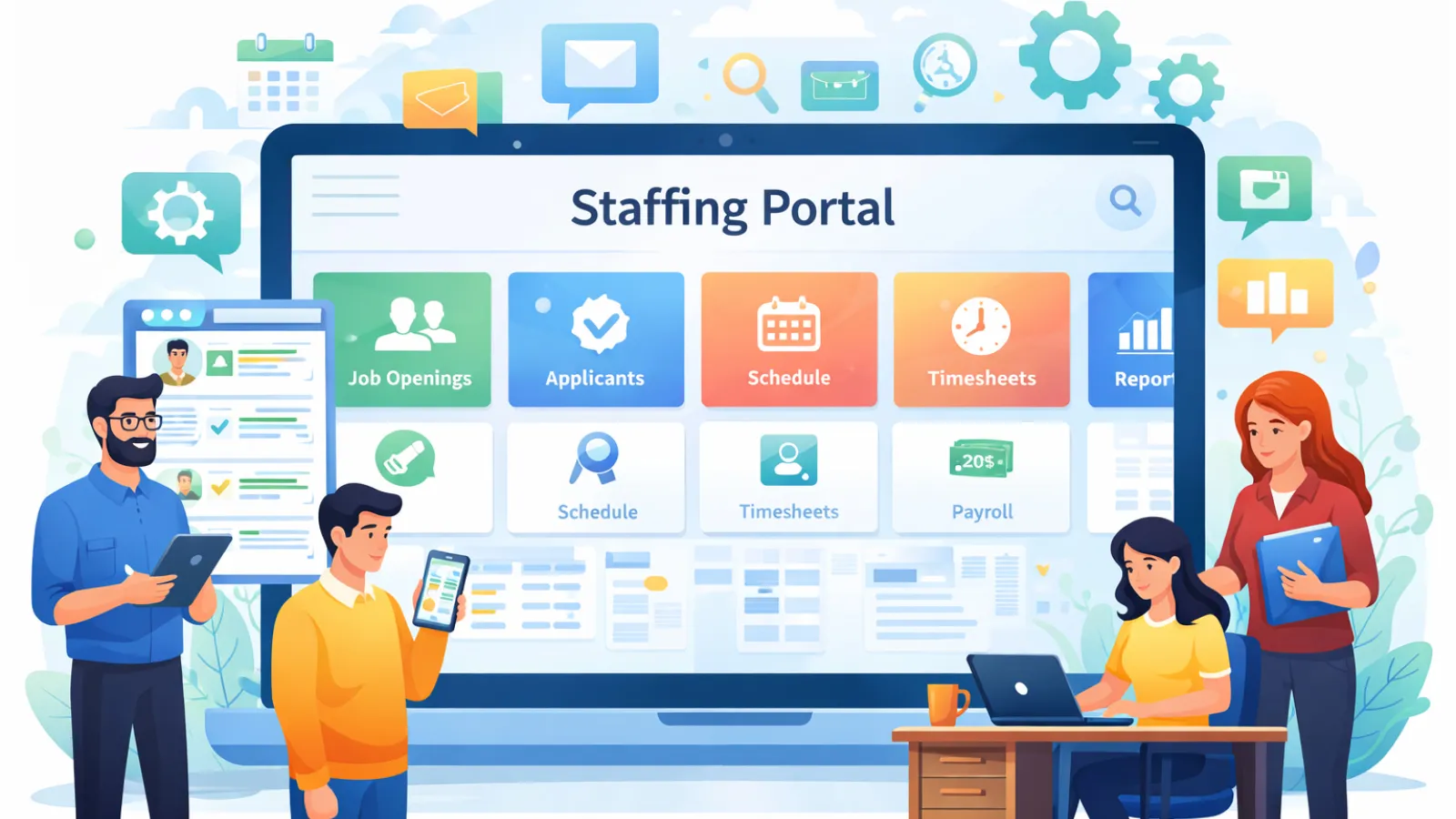

Around 70 percent of mid-sized staffing firms and a growing share of large enterprises now run at least part of their contingent workforce operations through a staffing portal.
The reason is straightforward. Manually managing temporary and contract workforce relationships through emails, spreadsheets and phone calls is no longer operationally competitive.
What the standard guides do not cover is what happens after the portal goes live, where the real complexity of adoption, compliance and power dynamics begins.
What a Staffing Portal Is and What It Is Built to Handle
A staffing portal is a secure web or app-based interface through which clients, agencies and workers interact around temporary assignments in a structured and auditable way.
Clients post job orders. Agencies assign or adjust consultants. Workers log time, view assignments and access pay data. All of this happens through a single login rather than scattered across inboxes and spreadsheets.
The core features that define the category are well established across the industry.
Core Features
| Feature Category | Core Functionality | Documented Benefit |
|---|---|---|
| Job Order Management | Client-submitted intake forms with role, shift, skills and location fields | 30 percent shorter job-order turnaround versus manual workflows |
| Timesheet and Expense | Worker submission routed to client or agency manager for approval | Eliminates data re-entry between requisition, timesheet and payroll |
| Compliance Tracking | I-9, W-4 and employment document management with expiry alerts | Creates audit trail, reduces manual document chasing |
| Worker Self-Service | Pay stub access, assignment viewing, personal detail updates | Removes routine calls to HR and payroll |
| Centralized Data | Contracts, orders, timesheets and compliance documents in one place | Replaces attachment-scattered inboxes with a single source of reference |
These functions are the table stakes of any staffing portal conversation. Every vendor covers them.
What most vendors and most guides do not cover is why implementations built entirely around these features still underperform, and what the four non-technical realities are that determine whether a staffing portal becomes operational backbone or expensive shelf-ware.
Behavioural Adoption Is the Real Bottleneck
Technology guides treat portals as if implementation solves the data flow problem. It does not. The real bottleneck is habit change, and it starts with clients, not workers.
Clients default to email, WhatsApp and verbal requests because those channels already produce fast responses. They know exactly who to call to get something done.
A staffing portal only displaces those habits if the firm builds explicit rules of engagement: job requests that do not come through the portal do not get prioritized.
That policy feels blunt, but without it the portal runs in parallel with the informal channels rather than replacing them, and the administrative duplication it was supposed to eliminate simply continues in a different form.
Worker adoption has its own failure pattern. Employees in hourly or blue-collar roles encounter the staffing portal as one more login in a sea of apps.
When the timesheet workflow requires five steps for a task that took thirty seconds with a paper form, abandonment rates climb regardless of how well centralized the underlying data is.
The genuine design tension here is between power and simplicity. A portal can be feature-rich and underused, or it can be minimalist and widely adopted.
The implementations that achieve sustained adoption consistently choose mobile-first workflows that match how workers actually operate, not how an idealized process map describes they should.
The Control vs. Speed Trade-Off Nobody Warns You About
A staffing portal does not just reorganize data. It fundamentally reshapes who controls information and when, with consequences that most organizations do not anticipate until they are already managing them.
When clients gain real-time dashboard visibility into open positions, timesheet status and spend, the agency loses the operational buffer that manual tracking previously provided.
That is genuinely positive for transparency and accountability. It also exposes every gap in data quality, SLA adherence and margin discipline in real time.
One documented pattern: agencies that launched client portals saw support tickets rise by approximately 40 percent in the first quarter following go-live.
Clients who could now see every status change questioned every variance. The ticket volume stabilized only after SLAs and exception-handling rules were formally codified inside the platform itself.
This is the most underappreciated truth about a staffing portal. It is not purely an efficiency tool. It is a contractual and cultural artifact.
How visibility, approval layers and alerts are configured effectively defines new norms for how client-agency relationships operate day to day.
Agencies that treat portal configuration as a technical task rather than a relationship-design decision consistently find themselves managing client expectations that the portal created but nobody planned for.
The Phantom Compliance Layer
Vendors market staffing portals as compliance-ready. The practical reality is more complicated, and the gap between what the marketing describes and what compliance teams actually experience is significant enough to warrant its own name: the phantom compliance layer.
Document expiry alerts only function if workers upload current documents in the first place. Many portals depend on manual follow-up from compliance teams to chase the uploads the system is supposed to automate.
Labor law edge cases present a second category of phantom compliance: cross-border assignments, overtime rules that vary by state, and union contract variations are rarely handled by standard portal configurations.
Users either build custom rule sets for each scenario or tolerate manual overrides that quietly erode the centralization the platform was supposed to deliver.
The practical framework that experienced staffing portal users apply is to treat the portal as compliance scaffolding rather than a compliance shield.
The portal creates the structure and the audit trail. It does not replace the manual audits, periodic spot checks and team training that real-world compliance enforcement still requires.
Organizations that deploy a staffing portal with the expectation that compliance is now handled are the ones that discover the phantom layer the hard way, usually during an audit.
Power Dynamics Between Agencies, Clients and Workers
Most standard guides frame the staffing portal as a win-win collaboration tool. The actual dynamics are more nuanced, and understanding them matters for how the platform is configured and governed.
Stakeholder Impact
| Stakeholder | Portal Benefit | Unreported Risk |
|---|---|---|
| Clients | Real-time visibility into positions, timesheets and spend | Raises pressure on agencies to keep margins thin and SLAs high |
| Agencies | Dashboard showcasing quality-of-hire, retention and SLA performance | Exposes operational gaps that manual tracking previously obscured |
| Workers | Self-service access to pay, assignments and scheduling | Digital logging of every shift, break and request creates surveillance risk |
For agencies, the staffing portal is increasingly a competitive differentiator rather than just an operational tool.
Firms that configure dashboards to surface quality-of-hire metrics, retention rates and SLA adherence win more premium contracts because they can demonstrate performance inside the platform rather than asserting it in a quarterly review.
For workers, the risk is less visible. When every shift start, break and leave request is digitally logged, the portal can function as a performance monitoring layer whether or not that was the original intent.
If managers begin tying incentives or penalties to portal-logged behavioral data, the self-service convenience the portal was built to provide has effectively become a surveillance mechanism.
The Glue vs. Core Architecture Question
Most staffing portal guides assume a vertical SaaS purchase that integrates with an existing ATS or payroll system.
What they rarely address is the foundational architecture decision that determines the long-term trajectory of the platform.
Glue-Layer Portal
A glue-layer portal sits on top of legacy ATS, payroll and HRIS systems without replacing them.
It orchestrates data between existing systems and presents a unified interface. It is faster to launch and lower-risk to implement.
The trade-off is that core logic, billing rules, assignment states and compliance calculations remain split across multiple systems.
Core-System Portal
A core-system portal consolidates contingent workforce data, billing logic and assignment management into a single domain model.
It is more complex to implement and requires more significant migration work.
The trade-off is a platform that can genuinely become the system of record.
Frequently Asked Questions
What is a staffing portal and how is it different from an ATS?
A staffing portal is a platform designed specifically for managing contingent, temporary and contract workforce relationships across their full lifecycle, from job-order intake through timesheet approval, compliance tracking and offboarding.
An ATS manages the recruitment and selection process for permanent hires.
Why do staffing portal implementations often underperform their projected efficiency gains?
The most common cause is behavioral adoption failure rather than technology failure.
How should a staffing portal handle compliance without creating a false sense of security?
The most effective approach treats the staffing portal as compliance scaffolding rather than a compliance guarantee.
What should organizations evaluate when deciding between a glue-layer and core-system staffing portal?
The core question is how much of the contingent workforce logic currently lives in legacy systems and how much of that logic needs to evolve.
Final Thoughts
The staffing portal that organizations need in 2026 is not the one with the most features.
It is the one configured with explicit behavioral rules that drive actual adoption, visibility architecture that manages client expectations, compliance scaffolding that acknowledges limitations, and an architecture philosophy aligned with operational complexity.
The technology is available. The implementation decisions determine the outcome.