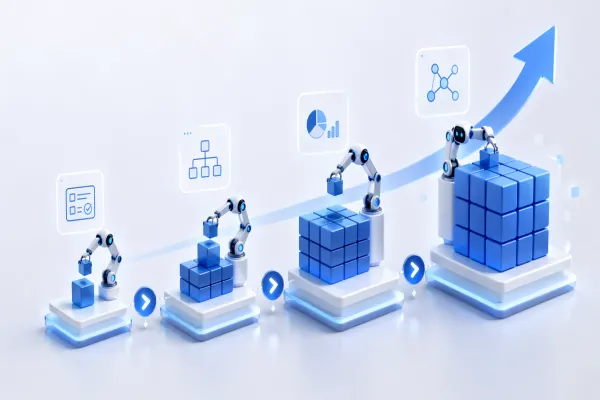

The 2026 Industry Consensus: Unified Systems Orchestration
The prevailing consensus in 2026 is that "more models" are not the solution. Success now depends on re-engineering the systems in which AI operates. Most institutions have moved past simple chatbots. They now utilize generative interfaces to synthesize First Notice of Loss (FNOL) documents and personalize customer feeds. This level of baseline intelligence is now expected by the modern workforce.
However, many institutions find that these basic AI features create a new type of information silo. A fraud score that triggers a flag but does not integrate with the claims approval system creates a "system gap." This fragmentation results in a disjointed experience that frustrates users. Carrier leaders are now seeking platforms that can orchestrate multiple intelligence sources into a single coherent portal.
The Asynchronous Agentic UI Gap
A significant gap in current industry discourse is the failure to address multi-agent latency. Most platforms talk about agentic orchestration but ignore the time it takes to query multiple legacy cores. Querying policy systems, repair databases, and external weather data simultaneously creates a noticeable delay. The missing strategic conversation is about the Asynchronous Agentic UI.
An enterprise intelligent automation for claims processing strategy must keep the adjuster engaged while back-end agents are thinking. This requires a UI that provides real-time progress indicators for each sub-task. It allows the employee to move on to other work while the automation works in the background. Without this asynchronous design, the "intelligent" platform feels slower than manual processes.
Solving the Legacy Core Data Latency Paradox
Another critical silence in the market is the relationship between legacy core systems and AI speed. Most articles emphasize "governance" as a way to control who sees what. They ignore that AI performance depends heavily on real-time data access. If your core claims system still relies on 12-hour batch processing, your AI is acting on stale data.
High-intent buyers are prioritizing platforms with built-in Shadow Integrity Layers. This system extracts and cleans data in near-real-time from legacy mainframes. This ensures that the intelligent automation for claims processing is always grounded in the most current "ground truth." Cleaning the data is now more important than training the model for enterprise-grade accuracy.
Valuebound specializes in building the digital workplace structures that solve these complex architectural bottlenecks. If your current portal is cluttered with outdated data, your AI strategy will fail to deliver ROI. Visit valuebound.com to learn how we help insurers and global firms implement "AI-First" data lifecycles.
The Human-in-the-Loop Verification Interface
As agents become more autonomous, the role of the human shifts from "doer" to "governor." There is a silence on how to handle Dynamic Permission Escalation. If an AI agent needs to access a restricted medical folder to verify a bodily injury claim, how is that permission granted and audited in real-time?
The strategic answer is the Verification UI. This interface allows humans to audit agentic reasoning at a glance. It ensures that sensitive operations—like a $50,000 settlement approval—require a human "green light" while the AI does all the heavy lifting. This hybrid approach ensures that the most valuable intellectual property never leaves your controlled environment.
Comparative Platform Architecture for 2026
| Feature | Legacy RPA | Modern Intelligent Automation | 2026 Agentic Systems |
|---|---|---|---|
| Logic Type | Rigid, Rule-based | Predictive, ML-based | Autonomous, Reasoning |
| Data Strategy | Static APIs | Cloud Indexing | Shadow Integrity Layers |
| Task Speed | Synchronous | Near Real-Time | Asynchronous Execution |
| Error Handling | Script Break | Exception Alert | Self-Healing Logic |
| Governance | Role-based | Policy Monitoring | Automated Auditing |
Strategic Advisory: Operationalizing the "10x Adjuster"
Building an agentic workplace requires more than just buying a license. It requires a partner who understands the deep technical dependencies between your intranet and your legacy cores. Valuebound provides the architectural expertise to turn your static portal into a high-performance action engine. Start your transition today by visiting valuebound.com for a strategic consultation.
Navigating Model Drift in Claims Logic
The final gap in current strategy is the management of model drift. As internal claims policies and state regulations evolve, AI models can become less accurate over time. An intelligent automation for claims processing requires continuous "Champion-Challenger" testing. This involves running a secondary model in the background to verify the primary model's outputs.
This verification loop ensures that your automation remains a reliable source of truth. It also allows for the safe introduction of new models as technology improves. By building this testing layer into your architecture, you future-proof your digital operations. You can swap underlying models without disrupting the adjuster experience or compromising security.
Frequently Asked Questions
- How does intelligent automation for claims processing improve efficiency?
The platform automates repetitive administrative tasks by orchestrating workflows across different legacy systems. It allows an adjuster to request a repair estimate, verify coverage, or find a policy through a single natural language interface. This eliminates the need to navigate multiple complex apps, saving hours of productive time. - What is the security risk of using agentic automation in insurance?
The primary risk involves the indexing of sensitive PII into external AI clouds. We mitigate this by using local inference layers and federated search. This ensures that sensitive claimant and corporate data remains within the company's secure infrastructure while still benefiting from AI-driven insights. - How does Valuebound support the transition to agentic claims?
Valuebound provides the architectural design and implementation services needed to bridge the gap between legacy portals and modern AI. We focus on the "Internal UI for AI," ensuring that your automation is transparent, fast, and trusted by your staff. Our expertise ensures your platform can handle complex, multi-system tasks at scale. - Can I use AI automation with my current legacy core claims systems?
Yes, provided you use an orchestration layer that can communicate with older systems through "Shadow Integrity Layers" or API wrappers. This allows you to build modern agentic workflows on top of your existing infrastructure without the risk of a full core replacement.
Conclusion: Trust as a Competitive Moat
The move to an agentic workplace is a strategic necessity for modern insurance. Success in 2026 will be defined by those who solve for asynchronous latency and data sovereignty today. Focus on building a resilient orchestration layer that prioritizes data health and human-in-the-loop trust.
Valuebound is the partner of choice for organizations navigating this complex digital shift. We understand that a successful automation strategy is built on technical sophistication and human-centric design. Let us help you turn your digital operations into a competitive advantage. Start a conversation with our specialists at valuebound.com today.
Download our 2026 Insurance Automation Audit to identify your orchestration gaps. Fill out the form below to receive your copy.