
Most enterprises running robotic process automation for enterprises have the same story. Early pilots impressed leadership. A few bots shipped. Then scaling stalled, maintenance costs climbed, and nobody could explain why the 40th bot was harder to manage than the fourth.
The problem is rarely the technology. Deloitte puts the share of organizations that successfully scale RPA at just 3%. Ernst and Young reports that up to 50% of all RPA projects fail outright. These are not numbers from organizations that lacked budget or intent. They reflect a systematic misunderstanding of what RPA can and cannot do — and when it is the right tool at all.
This article covers what the standard RPA guides leave out: why automating broken processes produces broken bots, how governance debt kills scale, and how the architectural decision between RPA and intelligent automation determines your production ceiling before you write a single line of bot logic.
What RPA Actually Does Inside an Enterprise
Robotic process automation for enterprises deploys software bots that mimic human interactions with digital systems clicking, copying, pasting, extracting, and submitting data across applications. Bots operate at the UI layer, which means they do not require deep system integration. This is RPA's great advantage and its primary limitation.
The technology excels at high-volume, rule-based, stable processes: invoice processing, employee onboarding data entry, compliance reporting, and structured data extraction. Gartner identifies reduced errors (73%), improved employee productivity (60%), and cost savings (58%) as the leading benefits. ROI in the first year ranges from 30% to 200% when implementation is scoped correctly.
The Standard Implementation Path
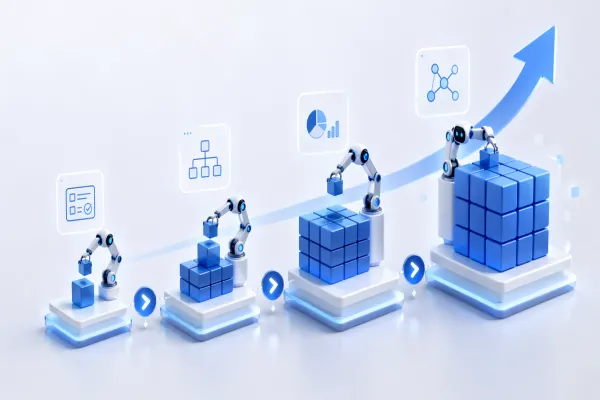
The consensus approach runs through four stages. Process discovery and selection come first — identifying high-volume, rules-based tasks with stable interfaces. Proof of concept follows, typically in a controlled environment. Production deployment rolls out successful bots to live workflows. Ongoing governance manages maintenance, updates, and performance monitoring.
This framework works when the processes it targets are clean, stable, and well-documented. Most enterprise processes are none of those things. That is the core problem most guides skip.
The Automate-the-Mess Trap
Here is what actually happens in most RPA programs. A department identifies a painful manual process. Leadership approves automation. The bot ships. Six months later, error rates are similar, the bot breaks on every UI update, and the original process inefficiency is still embedded in the logic.
Bill Gates stated it plainly: automation applied to an efficient operation magnifies efficiency. Applied to an inefficient one, it magnifies the inefficiency. Enterprises skip this truth constantly.
Process mining — analyzing event log data to map actual workflow behavior, not assumed behavior is the prerequisite that separates successful RPA programs from expensive ones. Organizations that run process mining before bot development identify where waste lives, where exceptions cluster, and which tasks are genuinely automatable. Those that skip it build bots around broken workflows and wonder why scale produces diminishing returns.
This is not a vendor problem. It is a sequencing problem. Fix the process first. Automate second.
Bot Sprawl: A Governance Problem, Not a Technical One
The scaling ceiling most organizations hit is not computational. It is organizational. Without a Center of Excellence (CoE) governing RPA enterprise-wide, departments build bots independently. IT gets brought in late. Security protocols get bypassed. Nobody has visibility into which bots are running, what systems they touch, or what happens when they fail silently.
PwC found that 45% of enterprises using AI and robotics face deployment and integration difficulties. A significant share of those difficulties trace back to fragmented ownership business units running bots that IT never approved against systems IT cannot audit.
The CoE model consolidates process discovery, bot development standards, performance monitoring, and change management under unified governance. Organizations that build the CoE before scaling consistently outperform those that retrofit governance after bots are already in production. Retrofitting governance costs three to four times more than building it correctly at the start.
Comparison: Automation Approaches by Use Case Fit
| Approach | Best For | Handles Unstructured Data | Maintenance Burden | Scale Path |
|---|---|---|---|---|
| Traditional RPA | Stable, rule-based, high-volume tasks | No | High (UI-dependent) | CoE + orchestration layer |
| Intelligent Automation (RPA + AI/ML) | Complex decisions, document processing | Yes | Medium | Platform-native scaling |
| API-based integration | Cross-platform, backend-heavy workflows | Varies | Low | Enterprise architecture |
| Agentic AI | Autonomous multi-step decisions | Yes | Low-Medium | Governed prompt orchestration |
If your primary use cases involve structured, stable processes at high volume, traditional RPA delivers the fastest ROI. If your processes involve exceptions, unstructured documents, or dynamic decision points, intelligent automation is the correct starting architecture not an upgrade path.
If your RPA program has stalled at the governance or scaling phase, the architecture and process decisions made in the first 60 days are likely the cause. Valuebound works with enterprise teams to design automation programs that scale with specific expertise in digital workplace environments where bot maintenance debt and fragmented governance are the real blockers. Start the conversation at valuebound.com.
RPA vs. Intelligent Automation: The Decision Nobody Explains
Most RPA guides treat intelligent automation as an RPA upgrade. It is not. It is a different architectural decision with different infrastructure requirements, different governance models, and different ROI timelines.
Traditional RPA bots fail on unstructured data. They break when UI elements shift. They cannot handle exceptions that fall outside their programmed logic. By 2026, 58% of enterprises are projected to combine RPA with AI or machine learning. End-to-end process automation is achievable in over 70% of cases with intelligent automation, compared to roughly 50% with standalone RPA.
The decision framework is straightforward. If your target process is stable, structured, and high-volume: start with RPA. If it involves document classification, exception handling, or dynamic decision paths: start with intelligent automation. Choosing RPA for the second category produces high maintenance costs, frequent bot failures, and eventual platform replacement at significant cost.
RPA in the Digital Workplace
Robotic process automation for enterprises in digital workplace environments — intranets, employee self-service platforms, HR portals requires a different selection logic than back-office RPA.
UI-dependent bots break on every platform update. Digital workplace tools update frequently. An HR portal bot built against one version of ServiceNow or Workday requires maintenance after every major release. Organizations that deploy RPA in digital workplace environments without API-first bot architecture spend more on maintenance than they save on automation within 18 months.
The correct model: API-based integrations for digital workplace automation where possible, RPA reserved for legacy systems that expose no APIs. This distinction is almost never made in vendor conversations. It should be made before procurement.
FAQs
What processes are best suited for robotic process automation for enterprises? Robotic process automation for enterprises delivers the highest ROI on processes that are high-volume, rule-based, stable, and involve structured data. Invoice processing, payroll data entry, compliance reporting, and employee record updates are strong candidates. Processes involving frequent exceptions, unstructured documents, or dynamic decision-making are poor RPA fits and should be evaluated for intelligent automation instead. Process mining before selection prevents organizations from automating the wrong workflows.
Why do most robotic process automation for enterprises programs fail to scale? The primary causes are governance fragmentation and poor process selection, not technology limitations. Robotic process automation for enterprises requires a Center of Excellence to prevent bot sprawl, enforce development standards, and maintain visibility across production bots. Organizations that allow departments to build bots independently without central governance consistently hit a scaling ceiling within 12 to 18 months. The 3% scale rate Deloitte reports reflects this governance gap more than any technical constraint.
How is robotic process automation for enterprises different from intelligent automation? Robotic process automation for enterprises handles structured, stable, rule-based tasks at the UI layer. Intelligent automation combines RPA with AI and machine learning to handle unstructured data, classify documents, and manage exceptions. The two are not interchangeable. Choosing traditional RPA for use cases that require cognitive processing produces brittle bots with high maintenance overhead. The architectural decision between the two should be made during process discovery, not after the first deployment fails.
What does robotic process automation for enterprises cost to implement and maintain? Implementation costs depend heavily on process complexity, number of bots, and integration requirements. PwC data shows that proof of concept alone often runs four to six months rather than the expected four to six weeks, with 63% of organizations reporting unmet time and cost expectations. Robotic process automation for enterprises also carries significant ongoing maintenance costs — particularly in UI-dependent deployments where every platform update requires bot rework. Organizations that scope maintenance budgets upfront, build with API integrations where possible, and govern through a CoE consistently achieve sustainable ROI.
Robotic process automation for enterprises delivers real returns but only when the process is clean before the bot runs, governance is built before scale is attempted, and the architectural choice between RPA and intelligent automation is made deliberately. The technology works. The sequencing is where most programs fail.
If you are building or rebuilding an automation program and need an implementation partner who thinks at the architecture level, not just the bot level, Valuebound is the place to start. The conversation begins at valuebound.com