
Meta Description:
The 7-Stage Legacy Modernization Roadmap delivers a practical phased approach with clear timelines, deliverables, and decision gates. Learn how enterprises achieve successful outcomes instead of the common 70% failure rate in digital workplace transformations. (157 characters)
7-Stage Legacy Modernization Roadmap
Why Most Modernization Efforts Fail
Legacy systems continue to consume massive enterprise budgets while slowing innovation and increasing operational risk. Organizations invest millions into modernization programs, yet nearly 70% of initiatives still exceed timelines, miss strategic goals, or fail to deliver meaningful business outcomes.
The problem is rarely a lack of technology options. Most enterprises already understand cloud migration, microservices, AI integration, and modernization frameworks. Failure usually happens because modernization is approached without enough structure, governance, or execution discipline.
A vague transformation plan quickly turns into uncontrolled scope expansion, competing priorities, and organizational fatigue. Teams become trapped between maintaining aging systems and attempting to build the future simultaneously.
Successful enterprises operate differently. They follow a phased roadmap with explicit deliverables, measurable business outcomes, and hard decision gates that prevent failing initiatives from consuming years of investment.
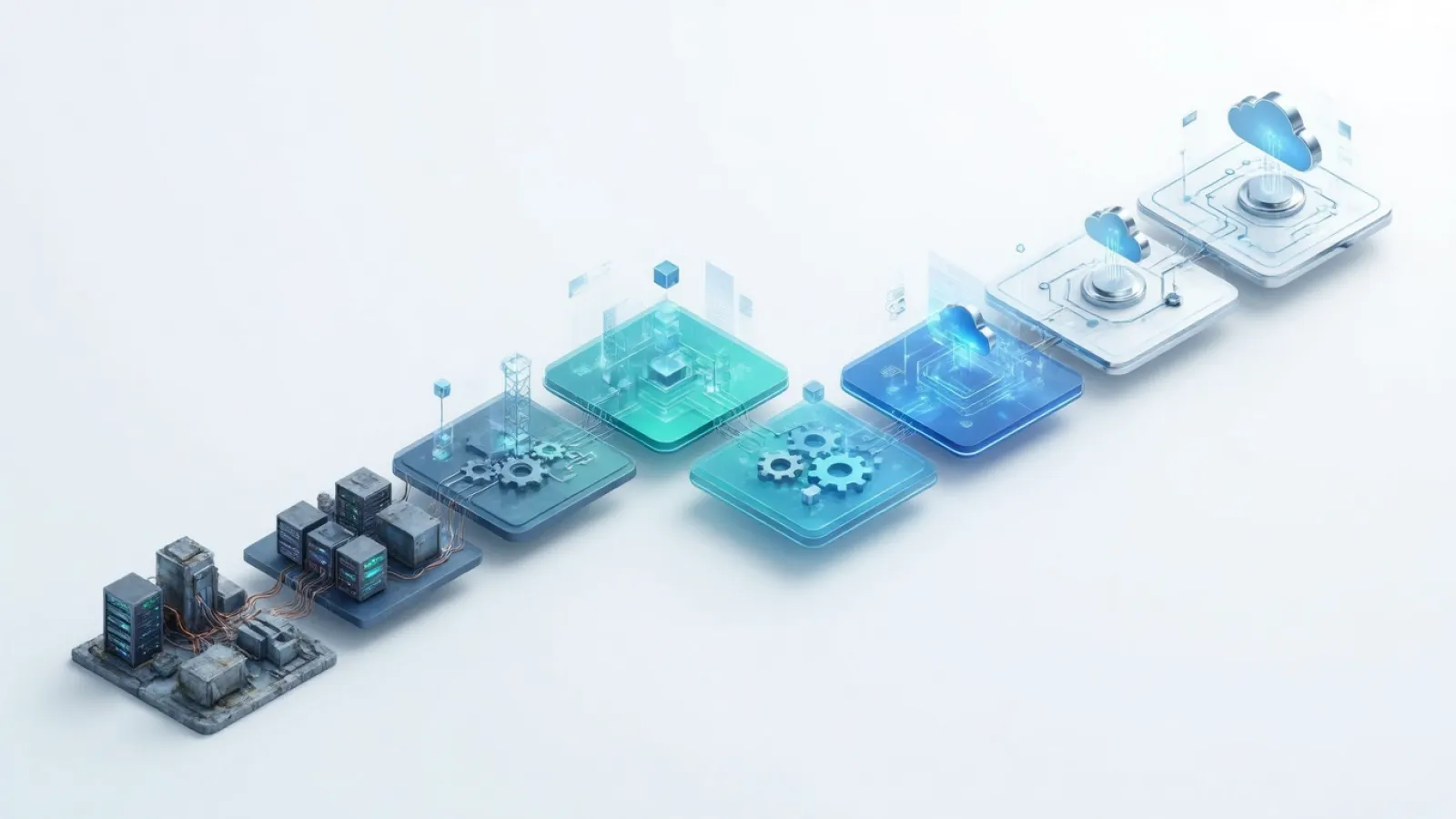
This guide outlines a practical 7-stage legacy modernization roadmap designed for enterprise-scale environments where operational continuity, compliance, and measurable ROI matter.
What Standard Roadmaps Get Right
Most modernization frameworks correctly recommend:
- Early technical assessment
- Incremental migration approaches
- Change management planning
- Pilot programs
- Cloud-native architecture adoption
- Business stakeholder involvement
These are important foundations.
However, standard frameworks usually stop at high-level recommendations. They rarely explain how large enterprises should sequence modernization over multiple years while maintaining governance, controlling risk, and preserving operational stability.
Experienced enterprise leaders need more than principles. They need:
- Realistic timelines
- Defined deliverables
- Executive decision checkpoints
- Risk escalation mechanisms
- Hybrid operations governance
- Business outcome tracking
The difference between successful modernization and expensive failure often comes down to operational discipline during execution.
Stage 1: Comprehensive Assessment (4-6 Weeks)
The first stage focuses on understanding the true complexity of the existing environment.
Most organizations underestimate hidden dependencies, undocumented integrations, and tribal knowledge embedded within legacy systems. This creates surprises later that dramatically increase timelines and costs.
A proper assessment includes:
- Application inventory mapping
- Infrastructure dependency analysis
- Security and compliance evaluation
- Performance bottleneck identification
- Integration mapping
- Technical debt assessment
- User workflow analysis
- Knowledge capture from key personnel
This stage should also identify systems approaching critical operational risk due to unsupported technologies or shrinking talent availability.
Key Deliverable
A comprehensive modernization assessment report including:
- System inventory
- Dependency maps
- Risk heatmaps
- Technical debt scoring
- Business criticality ranking
Decision Gate
Leadership reviews whether modernization priorities justify continued investment. Projects without strong business justification should pause before further spending occurs.
This stage prevents organizations from modernizing systems that no longer deliver meaningful strategic value.
Stage 2: Business Outcome Alignment (3-5 Weeks)
Many modernization efforts fail because technical goals overshadow business objectives.
Organizations often begin discussing frameworks, cloud platforms, or microservices before defining what success actually means.
Successful modernization starts with measurable business outcomes such as:
- Faster employee onboarding
- Reduced operational costs
- Improved customer experience
- Better compliance readiness
- Shorter release cycles
- Improved Microsoft 365 integration
- Reduced downtime risk
- Faster analytics delivery
Each modernization domain should be prioritized using a balance of:
| Criteria | Importance |
|---|---|
| Business Impact | High |
| User Visibility | High |
| Compliance Risk | High |
| Operational Dependency | High |
| Migration Complexity | Medium |
This alignment ensures modernization resources focus on areas that produce meaningful organizational value.
Key Deliverable
A prioritized modernization backlog with:
- ROI projections
- Business KPI definitions
- Domain prioritization
- Funding estimates
Decision Gate
Executive sponsorship and budget approval for the next modernization phase.
Without strong executive alignment, modernization programs lose momentum quickly during later hybrid operations phases.
Stage 3: Architecture and Strategy Design (6-8 Weeks)
Once priorities are established, organizations design the target modernization architecture.
This stage determines how modernization will actually occur across systems, teams, and business domains.
Key activities include:
- Selecting modernization patterns
- Designing target cloud architecture
- Defining integration strategies
- Establishing security models
- Planning hybrid operations
- Choosing observability platforms
- Designing governance frameworks
- Identifying AI-assisted tooling opportunities
Many enterprises now incorporate AI-assisted discovery and code analysis tools to accelerate dependency mapping and migration planning.
Modernization patterns may include:
- Strangler Fig Pattern
- Incremental domain replacement
- Containerization
- Event-driven architecture
- API-first integration
- Hybrid cloud deployment
Key Deliverable
A complete modernization architecture blueprint including:
- Migration sequencing
- Integration design
- Governance structure
- Security architecture
- Cost projections
Decision Gate
Leadership validates whether projected risk, cost, and timelines remain acceptable.
Strong architecture decisions at this stage prevent expensive redesigns later.
Stage 4: Pilot and Validation (8-12 Weeks)
Before enterprise-scale rollout begins, organizations must validate assumptions with a real production pilot.
This phase proves whether the modernization strategy actually works under operational conditions.
Successful pilots focus on:
- High-value domains
- Lower operational risk
- Visible business impact
- Manageable integration complexity
Examples include:
- Reporting systems
- Employee self-service portals
- Search functionality
- Workflow approvals
- Notification services
Pilot execution should include:
- Parallel operations
- Side-by-side validation
- Performance monitoring
- User experience testing
- Security validation
- Rollback readiness
Key Deliverable
A fully functioning production pilot with measurable business outcomes.
Decision Gate
Leadership determines whether:
- The modernization strategy should scale
- Architectural changes are required
- Additional investment is justified
This stage builds organizational confidence while exposing weaknesses early when corrections remain affordable.
Stage 5: Incremental Execution (3-9 Months Per Major Wave)
This is the longest and most operationally demanding stage.
Modernization proceeds domain-by-domain using incremental migration patterns rather than risky big-bang replacements.
Execution typically includes:
- Gradual traffic routing
- Parallel system operations
- Incremental service replacement
- Data synchronization
- Feature-flag controlled releases
- Continuous monitoring
Organizations must carefully govern hybrid operations because this phase introduces the highest operational complexity.
Key governance priorities include:
- Security consistency
- Unified observability
- Compliance continuity
- Data integrity validation
- Operational ownership clarity
Modernization waves should deliver visible business outcomes continuously rather than delaying value until final completion.
Key Deliverable
Modernized production domains with retired legacy components.
Decision Gate
Quarterly executive reviews evaluate:
- Business KPI progress
- Cost performance
- Operational risk
- User adoption
- Migration velocity
Programs that lose business alignment should adjust scope or pace before complexity grows uncontrollably.
Stage 6: Optimization and Scaling (4-8 Weeks Per Cycle)
After core migration waves stabilize, enterprises focus on optimization.
This stage unlocks the real long-term value of modernization investments.
Optimization areas include:
- Infrastructure cost reduction
- Performance tuning
- Security hardening
- Automation expansion
- Observability improvement
- AI capability integration
- Scalability enhancements
Successful enterprises standardize reusable modernization patterns across remaining domains to accelerate future migrations.
This stage often produces the largest operational efficiency gains.
Key Deliverable
An optimized production platform with scalable governance and automation capabilities.
Decision Gate
Operational leadership validates readiness for enterprise-scale expansion and long-term innovation initiatives.
Stage 7: Continuous Improvement (Ongoing)
Modernization should never end as a one-time initiative.
The most successful organizations build continuous modernization capability directly into operational culture.
Continuous improvement includes:
- Ongoing architectural reviews
- Technical debt monitoring
- Legacy retirement planning
- Cloud optimization
- AI adoption expansion
- Security posture improvement
- Platform engineering maturity
This stage transforms modernization from a reactive project into a sustainable competitive capability.
Key Deliverable
A living modernization playbook and institutional knowledge repository.
Decision Gate
Annual strategic reviews determine future investment priorities and modernization focus areas.
Comparison Table: Modernization Roadmaps
| Roadmap Type | Structure Level | Decision Gates | Typical Duration | Success Rate Indicator | Best Fit |
|---|---|---|---|---|---|
| Generic 3-Stage | Low | Few | 12-18 Months | Low | Small systems |
| Standard 5-Stage | Medium | Moderate | 18-36 Months | Medium | Mid-size projects |
| 7-Stage Disciplined | High | Strong | 24-48 Months | High | Enterprise modernization |
| Big Bang Replacement | Low | Weak | 12-24 Months | Very Low | Rarely recommended |
Mid Article CTA
If your legacy systems are slowing innovation, increasing operational risk, or blocking digital workplace transformation, Valuebound helps enterprises execute disciplined modernization programs that prioritize measurable business outcomes instead of risky technical rewrites.
Visit Valuebound to explore how this roadmap can apply to your organization.
FAQs
What makes the 7-Stage Legacy Modernization Roadmap different from standard approaches?
The 7-Stage Legacy Modernization Roadmap includes explicit timelines, measurable deliverables, and executive decision gates throughout the modernization lifecycle. This structure reduces uncontrolled scope expansion and improves execution discipline in large enterprise environments.
How long does enterprise legacy modernization usually take?
Enterprise modernization typically requires 24 to 48 months depending on system complexity, organizational size, compliance requirements, and integration depth. Incremental execution allows organizations to deliver value continuously during the journey.
Why do most modernization programs fail without strong governance?
Without governance, modernization priorities constantly shift, hybrid operations become unstable, and technical teams lose alignment with business objectives. Strong governance maintains execution discipline throughout long transformation programs.
What is the safest modernization strategy for large enterprises?
Incremental modernization using patterns such as the Strangler Fig approach is generally the safest strategy. It reduces downtime risk, maintains business continuity, and allows organizations to validate progress continuously.
When should organizations begin legacy modernization?
Organizations should begin modernization when maintenance costs dominate IT budgets, security risks increase, or legacy systems start blocking innovation, AI adoption, employee productivity, or customer experience improvements.
Conclusion
Successful legacy modernization requires far more than technology upgrades.
It demands disciplined execution, strong governance, realistic timelines, incremental delivery, and continuous alignment between technical strategy and business outcomes.
The organizations succeeding in 2026 are not necessarily the ones spending the most money. They are the ones modernizing systematically, validating continuously, and treating modernization as an enterprise transformation capability rather than a one-time IT project.
Valuebound partners with enterprises executing exactly these modernization journeys through business-centric modernization strategies designed for measurable long-term impact.
Learn more at Valuebound.
Download our complete Enterprise Intranet Buyer's Kit to structure your evaluation effectively. Fill out the form below to receive your copy.