
The Persistent Modernization Challenge
Legacy systems still power critical operations in most enterprises. They consume large IT budgets, slow innovation, and make integration with AI, cloud, and modern digital workplace platforms increasingly difficult.
Organizations need modernization without downtime, disruption, or catastrophic migration failures.
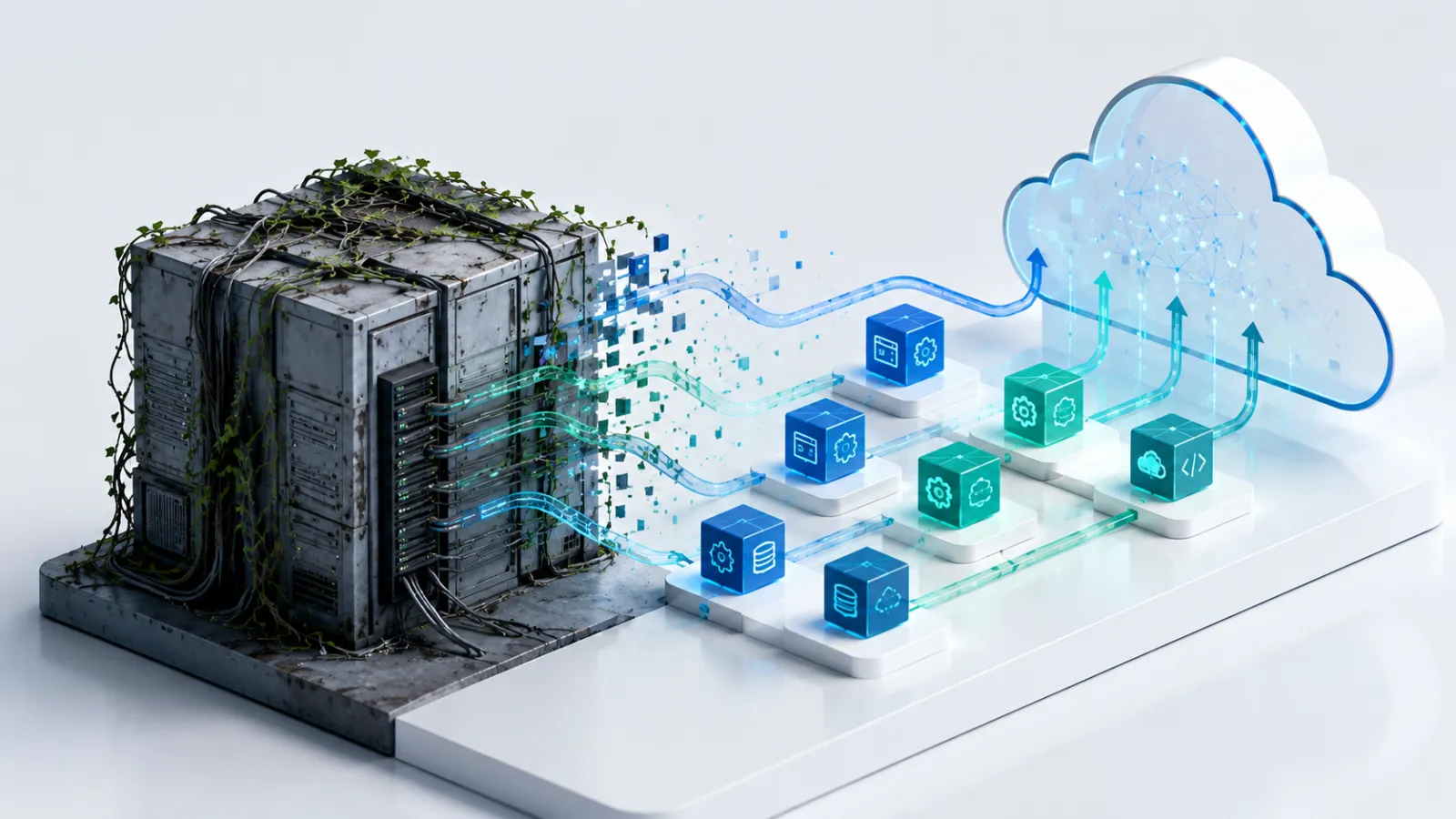
The Strangler Fig Pattern has emerged as one of the safest and most practical modernization approaches. Instead of replacing everything at once, it incrementally surrounds and replaces legacy functionality while the original system continues operating.
In 2026, AI has made this pattern even more effective. Enterprises can now accelerate discovery, dependency mapping, testing, and migration planning with AI-assisted tooling.
Most articles stop at the architectural concept. This guide focuses on what actually determines success in large-scale enterprise environments.
What Most Guides Cover
The Strangler Fig Pattern typically starts with a façade or routing layer placed in front of the legacy application. Requests are gradually redirected to newly modernized services until the old system can eventually be retired.
Most technical guides correctly explain:
- Incremental replacement reduces migration risk
- Business continuity remains intact
- Domain-based decomposition improves scalability
- Feature-by-feature migration is safer than big-bang rewrites
These principles are important foundations.
However, most failures occur not in theory, but during execution at enterprise scale.
Define Clear Business Outcmes First
Many modernization projects fail because teams start with technology instead of business outcomes.
Do not begin with cloud platforms, frameworks, or microservices decisions.
Start with measurable objectives:
- Faster employee onboarding
- Improved Microsoft 365 integration
- Reduced operational risk
- Better customer experience
- Lower compliance exposure
- Faster release cycles
Every migration slice should tie directly to business value.
This prevents teams from spending years rebuilding low-impact functionality that delivers little strategic improvement.
Successful organizations prioritize modernization domains using a balance of:
| Criteria | Importance |
|---|---|
| Business Impact | High |
| Migration Complexity | Medium |
| User Visibility | High |
| Compliance Risk | High |
| Operational Dependency | High |
Clear business alignment maintains stakeholder support throughout long modernization programs.
AI-Powered Discovery and Slicing
AI fundamentally changes how enterprises execute the Strangler Fig Pattern.
Traditionally, discovery phases consumed months of manual analysis. Teams struggled to understand undocumented business rules and hidden dependencies inside legacy systems.
AI accelerates this dramatically.
Organizations now use AI to:
- Analyze large legacy codebases
- Identify hidden dependencies
- Extract undocumented business rules
- Generate migration candidates
- Suggest domain boundaries
- Produce automated test cases
- Detect redundant functionality
- Surface integration risks earlier
AI-assisted slicing helps teams break monolithic systems into manageable business domains more accurately.
Instead of migrating blindly, enterprises gain visibility into architectural complexity before major execution begins.
This significantly reduces the risk of late-stage surprises that traditionally derail modernization initiatives.
Implement the Incremental Strangler Approach
Execution discipline determines whether the Strangler Fig Pattern succeeds or stalls.
Step 1: Build the Façade Layer
Introduce a routing layer between users and the legacy platform.
This façade controls traffic between old and new systems.
Requests can be routed by:
- Feature
- User segment
- Geography
- API type
- Business domain
- Feature flags
This creates flexibility while minimizing disruption.
Step 2: Start With Low-Risk, High-Value Domains
Avoid starting with mission-critical core transaction systems immediately.
Begin with domains such as:
- Reporting
- Self-service portals
- Search functionality
- Notifications
- Internal workflow tools
These areas deliver visible value quickly while reducing operational risk.
Step 3: Run Parallel Validation
Operate old and new services simultaneously during migration.
Validate outputs side-by-side before full cutover.
This protects operational continuity while improving confidence in migrated functionality.
Step 4: Use Feature Flags Aggressively
Feature flags allow controlled rollout and instant rollback.
This becomes critical during enterprise-scale migrations where even minor failures can impact thousands of users.
Incremental release patterns reduce organizational resistance and maintain trust throughout the transformation.
Govern Hybrid Systems at Enterprise Scale
The hybrid phase is where many modernization efforts lose control.
Running old and new systems simultaneously creates challenges around:
- Security consistency
- Identity management
- Data synchronization
- Compliance
- Monitoring
- Operational ownership
Without governance, hybrid complexity grows rapidly.
Successful organizations implement:
Unified Observability
Monitoring must span both legacy and modern environments.
This includes:
- Logs
- Metrics
- Traces
- Performance dashboards
- Security alerts
Fragmented monitoring creates blind spots.
Shared Governance
Modernization cannot remain an isolated IT initiative.
Governance must include:
- Business leadership
- Operations
- Compliance teams
- Security stakeholders
- Product owners
This prevents modernization drift and misaligned priorities.
Organizational Change Management
Users need visible progress and communication.
Small wins reduce resistance and build confidence across departments.
Without this, shadow processes and legacy dependency behaviors persist long after migration begins.
Avoid Common Strangler Fig Failure Modes
The pattern is powerful, but execution mistakes remain common.
Permanent Hybrid Architecture
Some organizations never fully retire the legacy system.
The façade layer becomes permanent technical debt.
Clear retirement milestones are essential.
Overly Broad Migration Slices
Large migration domains recreate big-bang risk.
Smaller bounded contexts improve agility and reduce failure impact.
Weak Governance
Without executive alignment and operational governance, modernization priorities shift constantly.
Projects stall midway.
Underestimating Integration Complexity
Legacy systems often contain undocumented integrations and business rules.
AI-assisted discovery helps reduce this risk but cannot eliminate it entirely.
Comparison Table: Migration Approaches
| Approach | Risk Level | Time to Value | AI Readiness | Enterprise Scalability | Common Pitfall |
|---|---|---|---|---|---|
| Big Bang Rewrite | Very High | Very Low | Low | Poor | Catastrophic failure risk |
| Lift and Shift | Medium | Medium | Low | Medium | Old problems remain |
| Basic Strangler Fig | Low | High | Medium | High | Migration fatigue |
| AI-Enhanced Strangler | Lowest | Highest | High | Highest | Requires strong governance |
If your enterprise is struggling with legacy modernization complexity, hybrid operational risks, or slow digital transformation, Valuebound helps organizations implement AI-enhanced Strangler Fig strategies that reduce disruption and accelerate measurable business outcomes.
Visit Valuebound to explore how incremental modernization can work in your environment.
Measure Progress and Accelerate Value
Many modernization programs fail because progress becomes invisible.
Track leading indicators consistently:
- Percentage of traffic migrated
- Legacy maintenance cost reduction
- Deployment frequency improvements
- User adoption rates
- Performance gains
- Business KPI improvements
- Security incident reduction
Visible progress builds organizational momentum.
The most successful enterprises treat modernization as a continuous capability rather than a one-time project.
This mindset shift separates sustainable transformation from expensive technical rewrites.
FAQs
What makes the Strangler Fig Pattern effective for legacy modernization?
The Strangler Fig Pattern enables incremental replacement while keeping systems fully operational. It reduces risk significantly compared to big-bang rewrites and delivers value continuously throughout the migration journey.
How does AI improve Strangler Fig modernization projects?
AI accelerates dependency analysis, code discovery, domain slicing, and test generation. This shortens timelines, improves migration accuracy, and surfaces hidden risks earlier in enterprise modernization programs.
What are the biggest risks in Strangler Fig implementations?
The biggest risks include permanent hybrid complexity, unclear governance, oversized migration domains, and stalled execution. Strong governance and incremental delivery help reduce these risks.
When should enterprises adopt the Strangler Fig Pattern?
Organizations should adopt the Strangler Fig Pattern when business continuity is critical and downtime is unacceptable. It works especially well for large enterprise systems that cannot be replaced safely in a single migration event.
Conclusion
The Strangler Fig Pattern remains one of the most reliable approaches for enterprise legacy modernization in 2026.
Combined with AI-assisted discovery and disciplined governance, it allows organizations to modernize incrementally while maintaining operational stability.
The enterprises succeeding today focus less on dramatic rewrites and more on controlled evolution, measurable business outcomes, and continuous modernization capability.
Valuebound partners with enterprises navigating exactly these modernization challenges through business-centric, AI-enhanced modernization strategies.
Learn more at Valuebound.
Download our complete Enterprise Intranet Buyer’s Kit to structure your modernization and digital workplace evaluation effectively. Fill out the form below to receive your copy.